Almost every consultancy has made the same first move with AI: give every consultant the best tools on the market — ChatGPT, Claude, Copilot — and let them work faster.
It works. Research, drafting and analysis genuinely speed up. But look at where that gain lands. It lands on the individual. The consultant gets faster; the firm does not. Judgement still sits in the same senior heads. Delivery logic is still scattered across decks and personal files. The firm’s IP still does not compound. And when a consultant leaves, the gain leaves with them.
Faster consultants. The same firm — in a market that has already moved on.
Because the market has moved. Clients increasingly will not pay for knowledge they can now generate themselves from an LLM. They want measurable outcomes, faster decisions, and advice that adapts as conditions change. Meanwhile the firm is still bound by headcount: revenue capped by people, growth dragging on margin. Used the instinctive way, AI can even make this worse — consultants producing faster the very outputs clients no longer value, quietly accelerating the commoditisation of the firm’s own services.
This is the real problem, and it is not a productivity problem. A faster consultant is not a scalable consultancy.
The move that actually changes the firm is a different one. It is not a better tool for the consultant. It is an AI layer for the firm — one that takes the delivery logic out of people’s heads and into something the firm owns, runs and improves. Something that lets the firm deliver outcomes consistently, whoever is in the room, and scale value without scaling headcount in direct proportion.
This is not, at root, a capability problem. It is an infrastructure problem. And that infrastructure has a name: a Consulting Operating System.
The clearest way to picture it is what the CRM did for sales. Before CRM, selling lived in individual reps’ relationships and notebooks. CRM did not just digitise that activity — it turned the way the firm sold into a system: visible, shared, and improvable. A Consulting Operating System does the same for how a firm delivers. It is the integrated layer where a firm’s structured expertise, decision-making, delivery, data, governance, client engagement and measurement work together — so outcomes are delivered consistently across every client, consultant and service line, and the firm improves with every engagement.
Earlier pieces in this series built the parts. Productised Consulting structured a firm’s expertise into IP. Outcome-Led Consulting organised it around measurable client outcomes. Outcome Pathways turned that into repeatable, evidence-led delivery. Each is necessary. None, on its own, is the system. The Consulting Operating System is the layer that runs them together, across the whole firm — which is what this piece is about.
The missing layer in consulting
Even in high-performing firms, the elements rarely connect. Expertise sits in documents. Pathways live in the heads of the people who designed them. Delivery depends on who is leading the engagement. Each piece may be productised, but they are stitched together by human judgement, not by a system.
That creates variability, dependency on specific people, and a model that is extremely difficult to scale reliably.
For a long time, that was manageable. The pace of change was slower, decisions were less frequent, and execution itself introduced enough friction to allow for correction.
That environment no longer exists. AI has removed most of that friction. Work moves faster, decisions are made more quickly, and execution happens almost immediately. But without structure, speed does not create progress — it magnifies inconsistency and lets poor decisions be implemented faster.
AI does not fix this model. It amplifies it.
Why this breaks at scale
As organisations accelerate, the limits of the consulting model become more visible. Decisions are happening more frequently, across more teams, with greater complexity — and often on the assumption that the confident answer coming back from an LLM is the right one.
The link between what is done and what actually drives the outcome becomes harder to trace, and harder to govern.
Without a consistent way to guide decisions and connect them to outcomes, the result is predictable: more activity, more output, more apparent progress — but not necessarily better results. At scale, misalignment compounds, effort is wasted, and value becomes increasingly difficult to prove.
What a Consulting Operating System actually is
It is not a platform that sits alongside the work. It is the environment in which the work happens — where the firm’s IP is curated, applied and continuously improved.
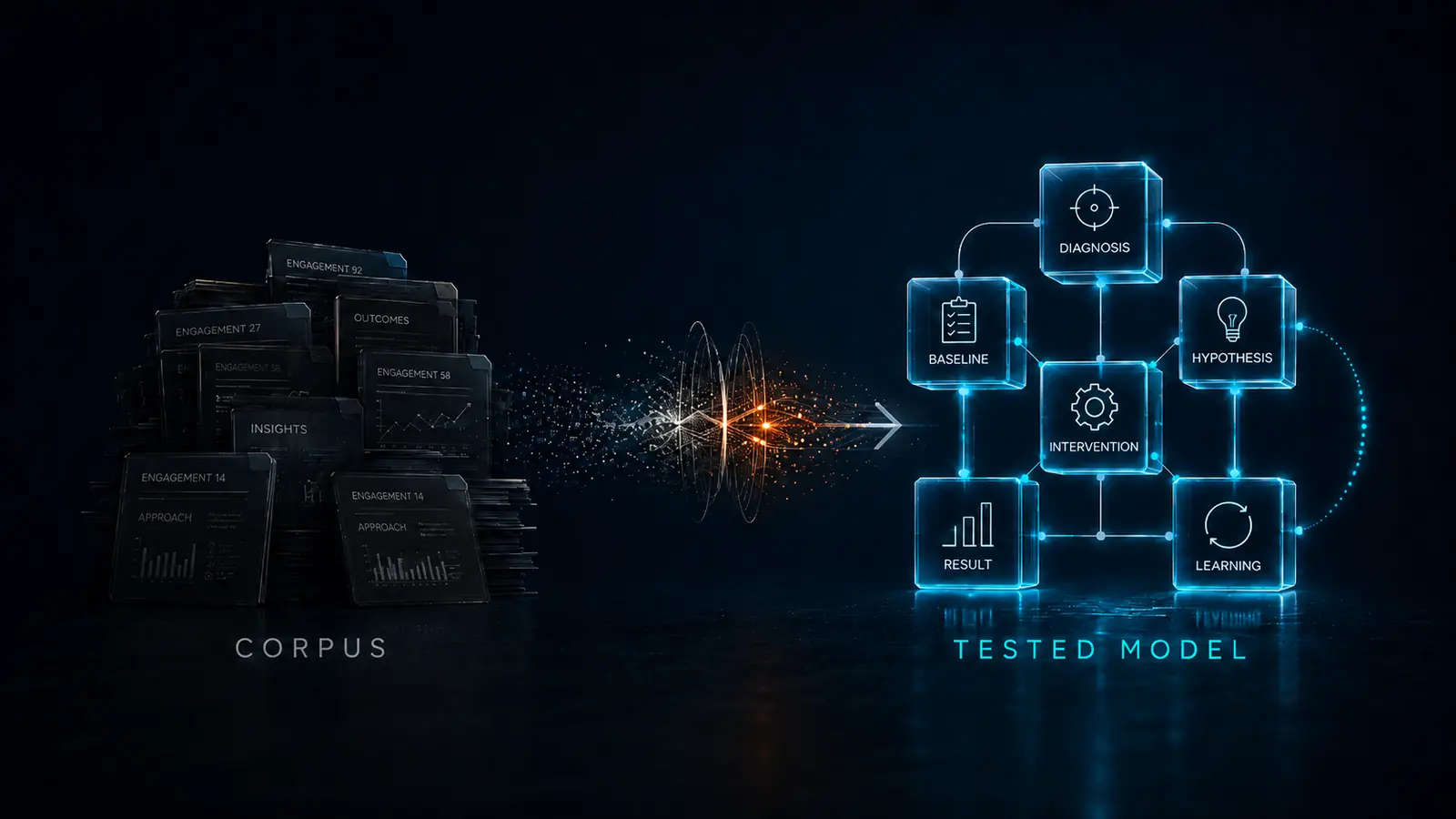
If an Outcome Pathway is how the firm’s logic runs through a single engagement, the Operating System is what runs many pathways across the whole firm: governed, reused, and learning from one another, so that every engagement makes the next one stronger.
Underneath it sits a common engine — the Atomic Model: outcomes, the capabilities that drive them, the evidence that proves progress, and the actions chosen to strengthen the right capability. The system applies that logic the same way regardless of who is delivering, which is what makes quality independent of who is in the room.
In practice, expertise is no longer scattered across individuals and documents. Decisions are no longer made in isolation. Delivery no longer depends on individual interpretation. There is one consistent way of operating that connects what the firm knows, what it does, and what it ultimately achieves.
The idea is not new in intent. What is new is that AI finally makes it practical to build and run at scale.
Why a system, not just better tools
Many firms believe they have already solved this, because they have invested in AI and in tooling — public LLMs, project management platforms, data environments and reporting dashboards.
These help organise work, track activity and surface information. But none of them defines how decisions are made, or how actions connect to outcomes. They support execution; they are not, in themselves, a system for decision-making.
That distinction is the whole point. Tools make the existing way of working faster. An operating system changes what the way of working is. Without it, the core constraint is left untouched.
What it changes in practice
When a Consulting Operating System is in place, the way consulting works changes fundamentally:
- The same problem is solved consistently across different clients, rather than reinterpreted each time.
- Decisions are made with shared context and data, not individual judgement alone.
- Actions are linked directly to measurable outcomes through the underlying Atomic Model.
- Progress is visible, not assumed.
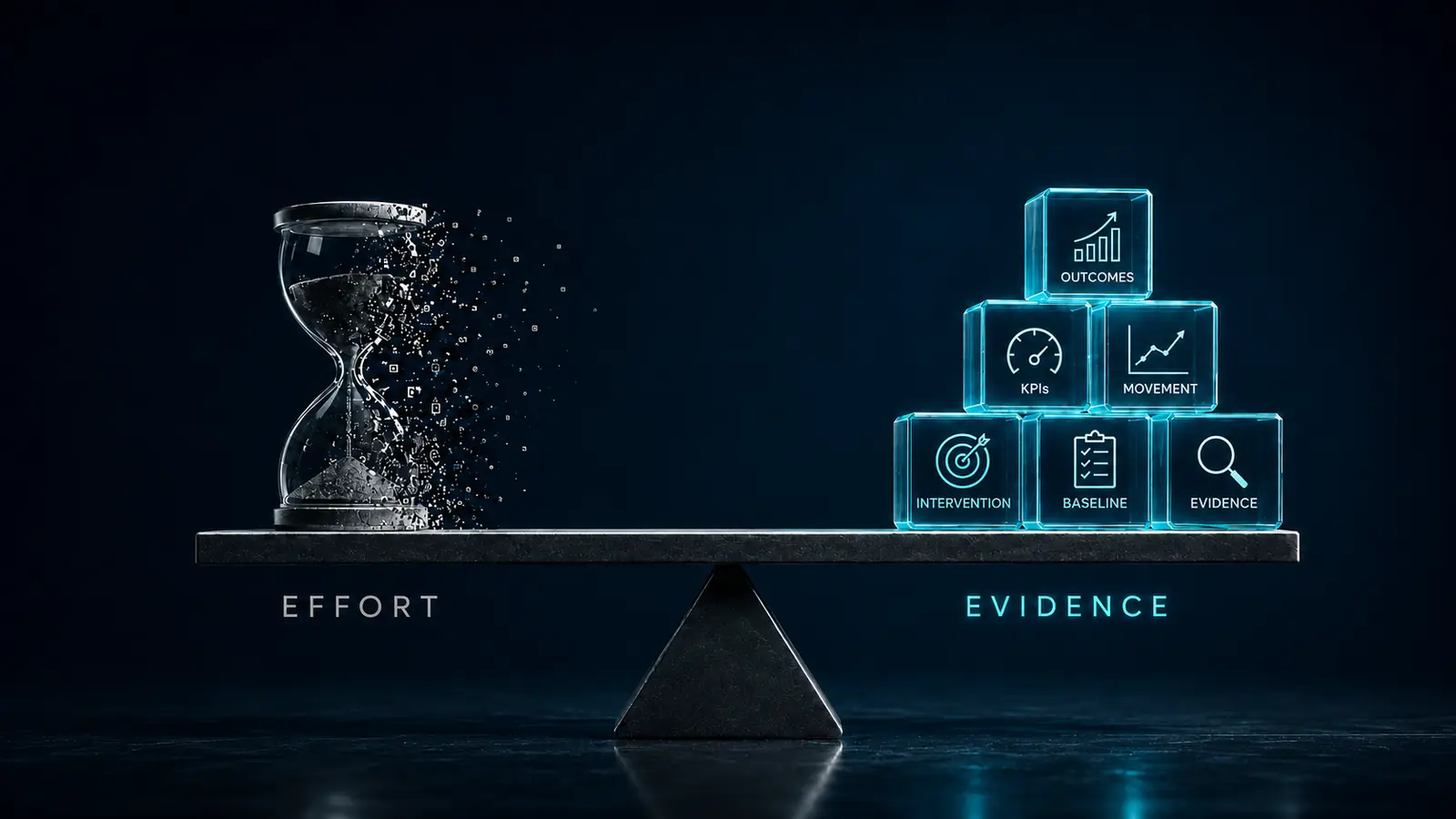
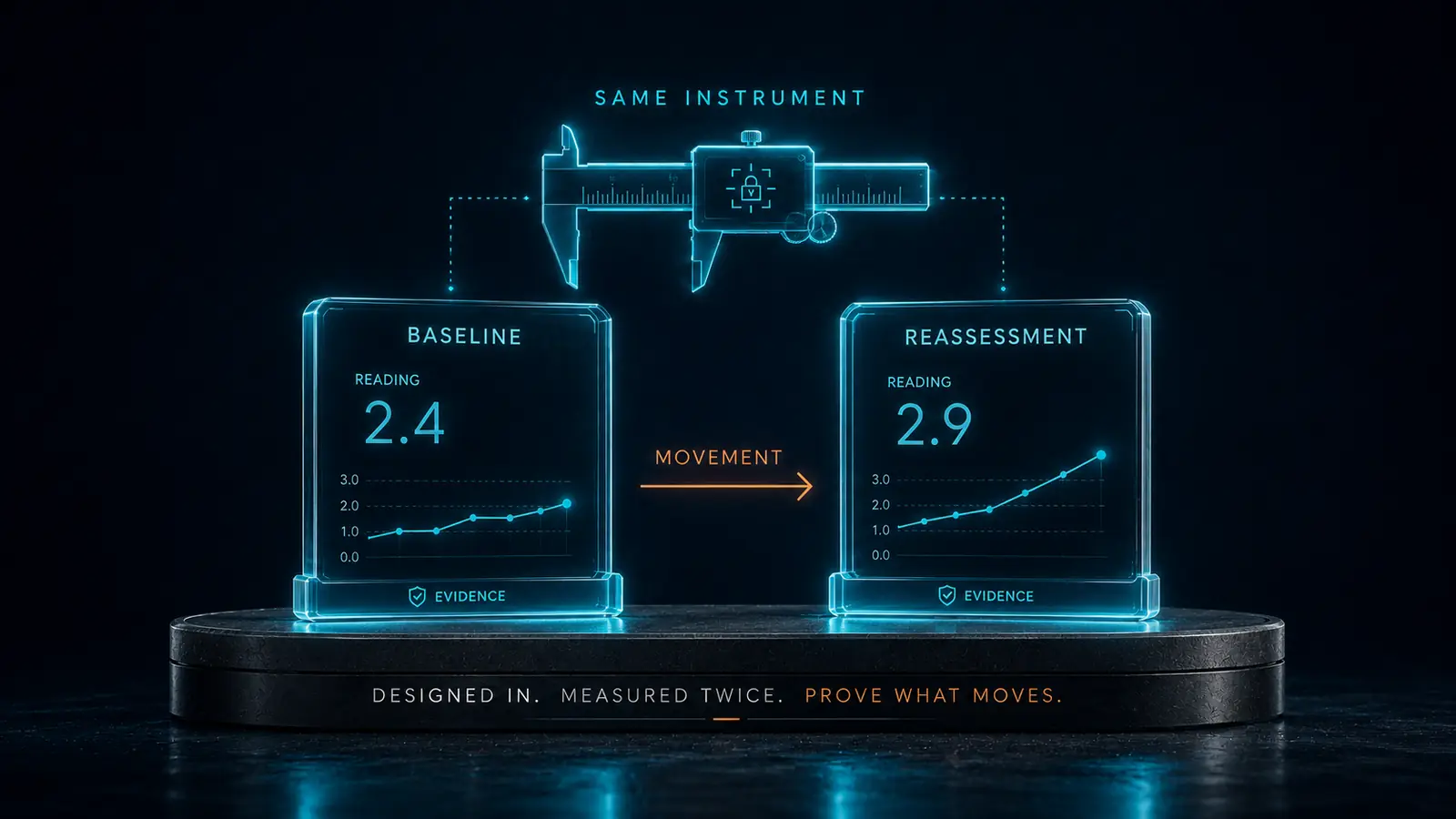
Most importantly, decision quality is governed, and outcomes are measurable and traceable. It becomes possible to see which actions led to which results — and to refine the approach over time on the basis of evidence rather than assumption.
That is what turns consulting from a series of engagements into a system of continuous improvement.
Where it sits in the sequence
A Consulting Operating System does not exist in isolation. It depends on everything that comes before it.
- Productisation structures the expertise into the firm’s IP.
- Outcome-Led Consulting defines what that IP is for.
- Outcome Pathways make the delivery of it repeatable.
- The Operating System brings those elements together and makes them run at scale.
Without Productisation, there is nothing to structure. Without Outcome Pathways, there is no logic to run. And without a system, none of it scales.
On the consultancy maturity ladder, this is the layer that sustains L4 — outcome-led, systemised delivery — and makes L5 possible, where the model compounds. Many firms are already moving in the right direction: productising parts of their expertise, defining outcomes more clearly, experimenting with structured pathways. But these elements often remain disconnected, and the firm improves pieces of the model rather than the model itself. This is why so many transformation efforts fall short. They build components, but not the system that makes those components work together — and that lets AI operate across them in a coordinated way.
The commercial effect
Once this infrastructure is in place, the economics of consulting begin to change. Growth is no longer tied directly to headcount. Delivery becomes more consistent. Outcomes become more measurable. Value is created over time rather than in isolated moments.
That opens the door to different commercial models — retained advisory, subscription engagements, outcome-linked pricing, and deeper client relationships. But the warning from earlier in the series still holds. This is the L3 trap: reaching for new commercial models before the operating model can reliably evidence and sustain progress. Those models are a consequence of the system, not the starting point. Pricing should follow structure, not lead it.
The risk of staying tool-rich and system-poor
Firms that do not build this layer will feel the impact quickly — and what they feel now is mild compared with what follows. As demand increases, delivery becomes more complex. Results vary more across engagements. Margins come under pressure as AI accelerates output but not value. And growth stays constrained by the need to add more people.
They will move faster, but not better, and not further. Eventually, that speed stalls.
Closing
Consulting is no longer only about thinking. It is about turning decisions into outcomes, consistently and at scale.
That cannot be achieved through people alone. It requires systems that connect expertise, decisions and delivery into a coherent whole. In an AI-enabled world, the advantage is not having better tools. It is having better infrastructure.
The firms that understand this will not just deliver consulting.
They will operate it.
Next in this series: Consultancy-as-a-System — where each engagement makes the next one better, and value compounds without headcount scaling with it.