The real strategic question today for consultancy leaders is not how to make your consultants faster with AI. It is how to build an AI layer for the firm - and to know how to do that, you need a view on what that layer actually looks like in delivery.
The trouble is this has never been seen before - AI is only just now entering the mainstream, there isn’t an existing model to follow - it’s a new frontier for consultancy. So where do you start when there is no tried and tested point of reference? Read on, and I will give you my view based on research, conversations with industry leaders, and deep practical experience of delivering consultancy, and building AI solutions to solve the problems I have experienced first hand.
Most consultancy leaders are now asking some version of the same question: how do we make the firm scalable, faster, and fit for an AI world of changing client demands and the need for new business models — from outcome-based pricing to new types of advisory subscription services?
The instinctive answer, the one firms have followed so far, is to get everyone in the firm using AI (or, to be specific, public LLMs) - so they can deliver faster research, faster decks, faster first drafts.
But think - that helps individuals. Does it really do much for the firm?
A hundred consultants each prompting their own AI is a hundred private productivity gains that walk out of the door with the people who made them. The firm is no more scalable than it was. The business model is the same. It is simply quicker at producing the same outputs, in the same inconsistent way, dependent on the same senior heads (but maybe a few fewer juniors).
It suggests that today firms are answering the wrong question with AI. AI’s real value for firms isn’t in individual consultant productivity.
The more important question is different: how do you build an AI layer for the firm itself - something that makes the organisation more capable and scalable, and opens new revenue and growth opportunities, rather than just making its individuals more efficient?
That takes two things.
First, you must systemise the knowledge and expertise that currently lives in senior heads, decks and tacit judgement, and turn it into the firm’s IP. This is Productisation, the subject of an earlier piece in this blog series, and it is the foundation where all consultancies need to start today. Curating and structuring expertise and best practice in data models that enable AI to use it effectively. In case you are asking, this is not loading files into an LLM and asking the LLM questions — that isn’t the answer.
The blog that followed it went on to argue for Outcome-Led consulting — organising that IP around a clearer purpose for clients — measurable client outcomes rather than outputs. Together they answer what the firm knows and what it is for.
But as powerful as these building blocks are, neither answers how the firm delivers it. And without delivery, the IP just sits in a system, unused — codified, but never applied to a live client.
Codified expertise is inert until something applies it — to a specific client, in a specific context, repeatably, and in a way that adapts as the engagement unfolds. A knowledge base does not change this; it still leaves the meaning trapped in the document, where every consultant, system or agent that meets a term has to interpret it again. IP sitting in a library does not deliver itself.
The firm needs a second layer: a workflow layer that takes the IP and runs it as structured, evidence-led delivery - the same way, to the same standard, regardless of which consultant is leading the engagement.
This piece is about what that workflow layer looks like.
It is something I have called an Outcome Pathway - for want of an existing term — new to consultancy in the way it is systemised, but familiar in the way it works.
What an Outcome Pathway Is
An Outcome Pathway is a structured, systemised and AI-enabled sequence of decisions that connects a client’s current state to a defined outcome - operating with context, data and continuous learning to guide what happens next.
It is not a static plan, and it is not a methodology document. It is the workflow layer: the route through which the firm’s IP is actually applied to a live engagement. It defines what matters most, determines the next best step, guides execution, measures impact through evidence, and adapts as conditions change.
The pathway does not invent new logic. It runs on the logic the previous piece established - the Atomic Model of consulting — and makes it operate as a system rather than as the private judgement of whoever happens to be in the room.
Four elements do the work, and the pathway is what connects them: outcomes (what success looks like, and the fixed point), capabilities (what must improve, because capabilities drive outcomes), evidence (the KPIs that show whether progress is real), and actions (what is executed, chosen to strengthen the right capability rather than picked on intuition).
The chain is simple: actions improve capabilities, capabilities drive outcomes, evidence validates progress. And the discipline that keeps a pathway honest is one line worth holding onto - actions adapt as evidence changes, while the outcome remains constant. The destination does not move. The route does. And the system intelligently guides it.
Familiar Ingredients, Different Architecture
None of this claims consultancies have never scoped a problem, run a diagnostic, facilitated a workshop or tracked a KPI. Of course they have. Transformation firms will recognise benefits logic; operational excellence firms, root-cause thinking; change firms, adoption journeys; strategy firms, hypotheses and decision points. Every good consultancy already has the fragments of a pathway.
The ingredients are familiar. The architecture is not.
In most firms, those fragments are connected by human judgement, not by a system. The diagnostic exists, but the interpretation lives in people. The workshop is repeatable, but the insight depends on who facilitates it. The report follows a standard format, but the recommendations rest on individual experience. This is not a criticism - it is how consulting has always worked.
The problem is that it creates dependency: if the logic only comes together when the right senior person is in the room, the firm cannot scale value without scaling senior attention. An Outcome Pathway does not remove the consultant; it externalises the repeatable logic they would otherwise carry in their head - making it visible, governable and reusable — and leaves them free to do what only they can do.
What It Looks Like in Practice
So, what does the workflow layer actually look like when it is running?
It does not look like a Gantt chart. A project plan marches in a straight line, rain or shine - a fixed sequence of tasks with the evidence arriving at the end, if at all. A pathway looks different because it manages progress rather than work.
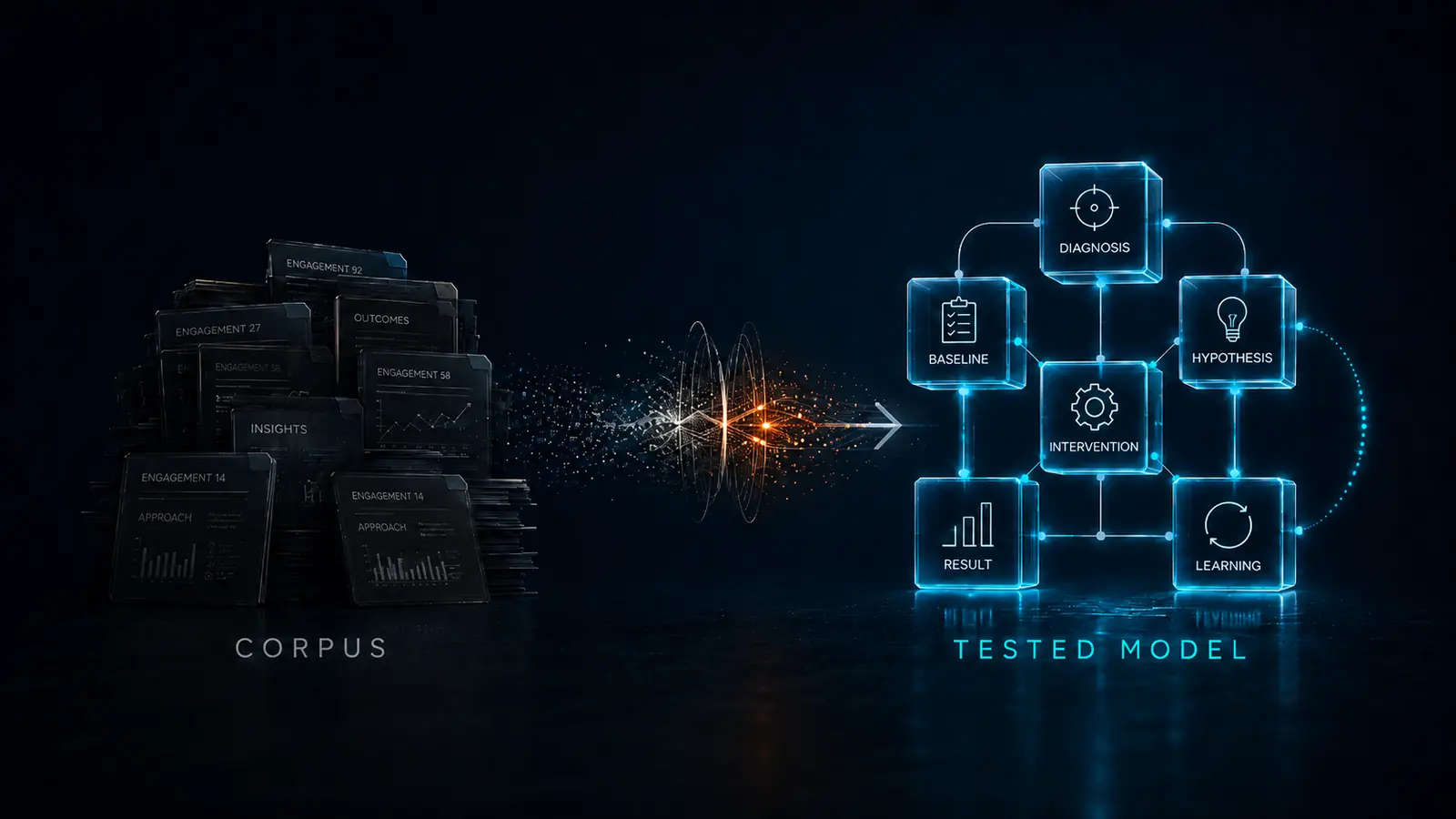
At its heart is a repeating loop: hypothesis → baseline → act → measure → adapt.
The engagement opens with a hypothesis about which capability, if strengthened, will move the outcome. Baseline data captures the starting state. An action follows as a test of that hypothesis. The evidence is checked - is it working? — and the route adapts before the next step is taken.
Across an engagement, that loop runs through a recognisable shape: frame the problem and form the hypothesis, diagnose and baseline the capabilities, validate the findings, sequence the actions into a route, deliver, and measure the outcome - with adaptation and learning built in at every checkpoint rather than bolted on at the end. The consultant is never asking “what does the plan say next?” They are asking the question the pathway is built to answer:
“Given where you are now, this is the next best step.”
Then the next. And the next. The pathway looks more involved than a plan because the work in the real world genuinely is — it makes that complexity explicit instead of pretending it does not exist. It’s how a good consultant operates regardless of the documented plan, and it’s how a system assisting them should also work.
From Activity to Evidence
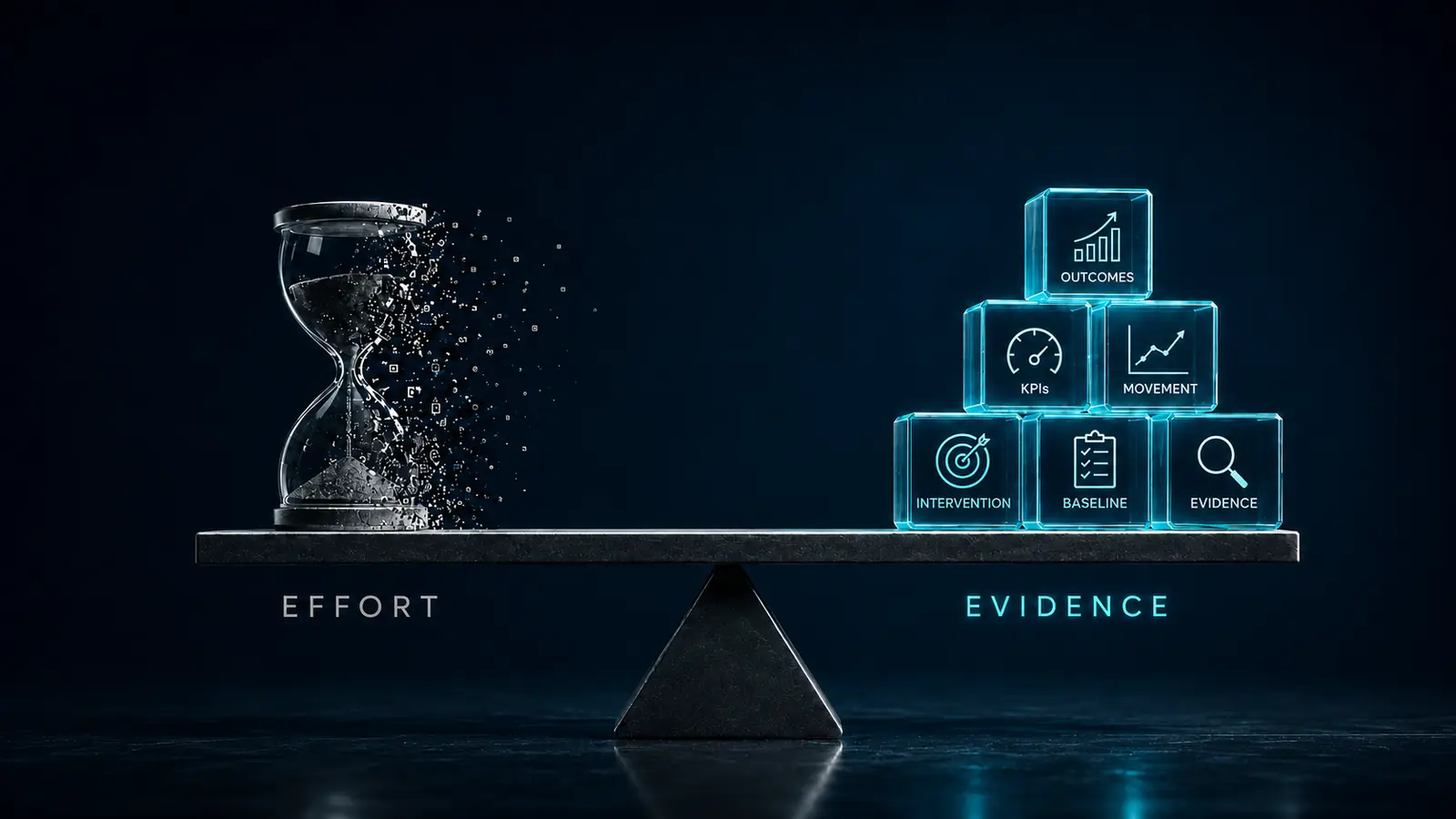
In most engagements, activity is mistaken for progress. Work is happening, initiatives are running, outputs are being delivered — and the outcome remains unclear.
A pathway changes that by putting evidence into every step.
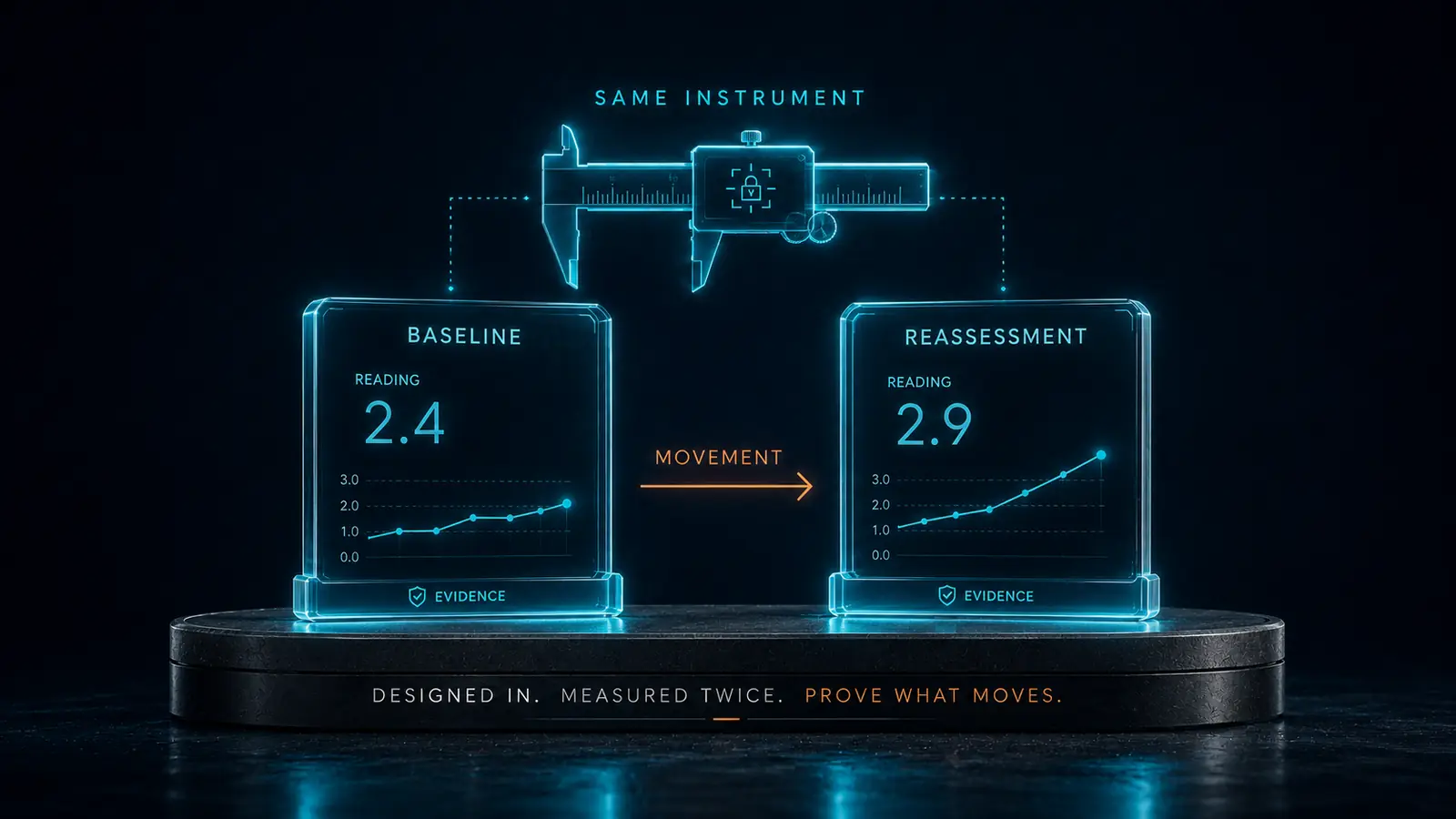
Capabilities are baselined and measured. Outcomes are tracked. Actions are evaluated against a single question: did this actually move us closer to the outcome, and if not, what do we change?
Where the traditional model assumes the causal link between activity and result, the pathway tests it. The shift is from intuition to evidence -; not from human judgement to mechanical logic, but from judgement that can never be examined to judgement made visible enough to be checked, corrected and repeated.
With the correct design and application of AI within workflows, this is exactly what a firm can achieve. This is not conceptual; it is the practical value AI can provide at the firm level — and we will see this, or some version of it, in every consultancy very soon.
The Firm’s AI Layer, Not the Individual’s
This is where the opening question gets its answer, and where the distinction between individual AI use and a firm-level AI layer becomes concrete.
When the pathway is systemised, AI stops being a personal productivity tool and becomes part of how the firm operates. It can support diagnosis, sequence interventions, track evidence, flag risk, surface patterns and help the firm learn across engagements - because the logic it is amplifying is the firm’s, captured in the pathway, not improvised in one consultant’s chat window. For that to work, the firm’s logic has to live in shared structure, not in the artifact or the prompt where it has to be re-read and re-interpreted every time it is used.
AI increases the speed of execution, the volume of decisions and the complexity of operations. Without a workflow layer, that produces noise - the wrong actions executed faster, with nothing learned. With one, the same conditions produce learning. Each action generates data. Each result informs the next decision. Decision quality improves through evidence rather than assumption, and the firm’s IP improves with it.
That is the line between AI that makes consultants faster and AI that makes the firm more scalable. The first leaves with the individual. The second compounds inside the organisation. A faster consultant is not a scalable consultancy.
What This Changes — for the Firm and the Client
For the firm, the role shifts — from delivering recommendations, running isolated projects and relying on individual expertise, towards structuring decision-making, guiding continuous progression and operating systems of improvement.
This does not diminish the consultant. The relationship, the judgement, the context, the challenge — those remain human, and they remain where the consultant adds most value. What changes is that the consultant no longer has to carry every piece of repeatable delivery logic in their head. The consultant leads the relationship; the system carries the logic. That division of labour is what makes the model scalable, and it is what stops senior people becoming the bottleneck on every engagement.
It changes the client’s experience too. In a traditional engagement the client sees a strong workshop, then a report, then a plan, then status updates — but the live logic connecting those moments to the outcome they care about is rarely visible. A pathway makes it visible: the client can see the outcome being pursued, which capabilities are being assessed and why, why specific actions are recommended, and whether progress is actually happening. That is a different kind of trust — the client is no longer buying expertise and waiting for outputs; they are participating in an evidence-led progression towards an outcome they helped define.
The commercial effect follows the structure. Engagement becomes more continuous, progress can be evidenced, and renewals are justified by observed capability uplift rather than goodwill alone - which is what makes retained advisory, subscription models and outcome-linked pricing defensible, and even obvious as an outcome of systemisation.
The unit of value shifts with it. Historically the project has been the thing a client buys, the firm delivers, and either renews or does not. In an outcome-led model, the pathway becomes that unit - sold, delivered, measured, improved and reused. The firm is no longer only selling access to expertise; it is selling a structured route to a measurable outcome, which is far harder for the market to commoditise.
But the sequencing warning from the previous piece still holds. This is the L3 Trap: reaching for outcome-based pricing before the operating model can reliably evidence and sustain progress. Pricing should follow structure, not lead it. The pathway is what earns the commercial model, not the other way around.
The Bridge, Not the Destination
Outcome Pathways are not the end state for a consultancy. They are the bridge. Without them, an outcome-led model cannot be delivered consistently, productised expertise cannot be applied dynamically, and continuous improvement cannot be sustained. With them — and embedded within a Consulting Operating System - they become scalable, repeatable and continuously improving.
Stated simply: Productisation packages what the consultancy knows; Outcome Pathways systemise how that knowledge creates progress. That is the move from L3 to L4 on the consultancy maturity ladder.
The dependency chain is worth restating, because it is easy to skip a step. Productisation structures the expertise into the firm’s IP. Outcome-Led Consulting defines what that IP is for. Outcome Pathways make the delivery of it repeatable. Consulting Operating Systems make it scalable. Consultancy-as-a-System is the next destination, and where the model compounds. Each stage rests on the one before it.
Closing
The question a consultancy leader is really asking is not how to make people faster. It is how to make the firm itself scalable and fit for an AI world - how to build an AI layer that belongs to the organisation rather than the individual.
That layer has two parts: the IP that systemises what the firm knows, and the workflow layer that delivers it. The Outcome Pathway is the workflow layer. It is how codified expertise becomes structured, evidence-led delivery that any consultant can run and the firm can improve with every engagement.
In a world where knowledge is abundant and execution is instant, the advantage is no longer having better ideas. It is the ability to decide what matters most, take the right action next, and adapt continuously on the evidence - consistently, across the firm. That is what a pathway makes possible, and it is what lets a consultancy finally do at scale what it has always aimed to do: deliver client outcomes.
Next in this series: The Consulting Operating System — how Outcome Pathways are run across an entire firm, governed and reused so that every engagement makes the next one stronger.