TheAX · the expertise layer

Build your expertise layer. Then run and improve it on every engagement.

Your firm’s expertise is person-held, not firm-owned, and that caps how far it can scale. TheAX is the assessment and diagnostic platform that turns how your best people diagnose, decide, advise and prove value into a layer the whole firm can run - and sharpens it with every engagement.

How TheAX helps

Build the expertise layer. Then use it on every client.

Two things in TheAX are proprietary, and there is one for each move.

01 · Build the layer

TheAX captures how your best people think and structures it as a Consulting Atomic Model.

The outputA firm-owned expertise layer. Senior judgement becomes a reusable capability rather than knowledge trapped in individuals.

02 · Use the layer

Our AXAT algorithm reads that model and turns collected data into diagnosis and advice.

The outputData-led delivery at scale. Any consultant works from the firm’s best expertise, while your people keep the judgement, the relationship and the intervention.

How it works

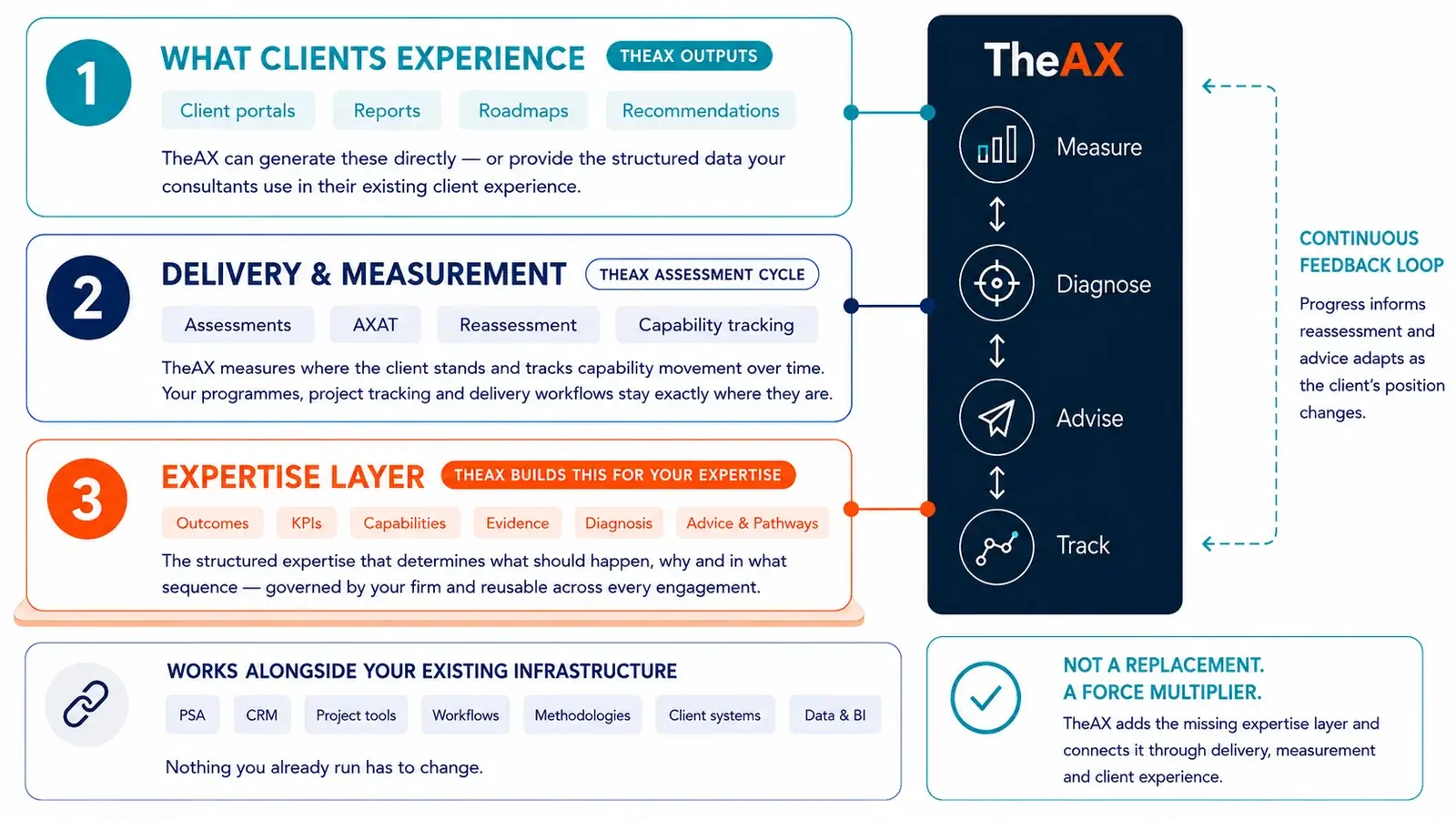
A scalable consultancy runs on three layers. Most firms are missing the one the other two depend on.

Most firms run the operational layer well - CRM, project tracking, billing, document stores. What almost none of them have is diagnostic and outcome tracking that runs on their own expertise. TheAX adds that layer alongside the systems you already run, not instead of them.

The three layers a scalable consultancy runs on. Layer one, what clients experience, produced as TheAX outputs: client portals, reports, roadmaps and recommendations - TheAX can generate these directly or provide the structured data your consultants use in their existing client experience. Layer two, delivery and measurement, the TheAX assessment cycle: assessments, AXAT, reassessment and capability tracking - TheAX measures where the client stands and tracks capability movement over time, while your programmes, project tracking and delivery workflows stay exactly where they are. Layer three, the expertise layer, which TheAX builds for your expertise: outcomes, KPIs, capabilities, evidence, diagnosis and advice and pathways - the structured expertise that determines what should happen, why and in what sequence, governed by your firm and reusable across every engagement. All three connect to the TheAX cycle of measure, diagnose, advise and track, with a continuous feedback loop in which progress informs reassessment and advice adapts as the client’s position changes. TheAX works alongside your existing infrastructure - PSA, CRM, project tools, workflows, methodologies, client systems and data and BI - so nothing you already run has to change. It is not a replacement but a force multiplier, adding the missing expertise layer and connecting it through delivery, measurement and client experience.

The six parts

TheAX curates your expertise so you can run it on every engagement. It does that in six parts.

Where your expertise is structured
Part 01

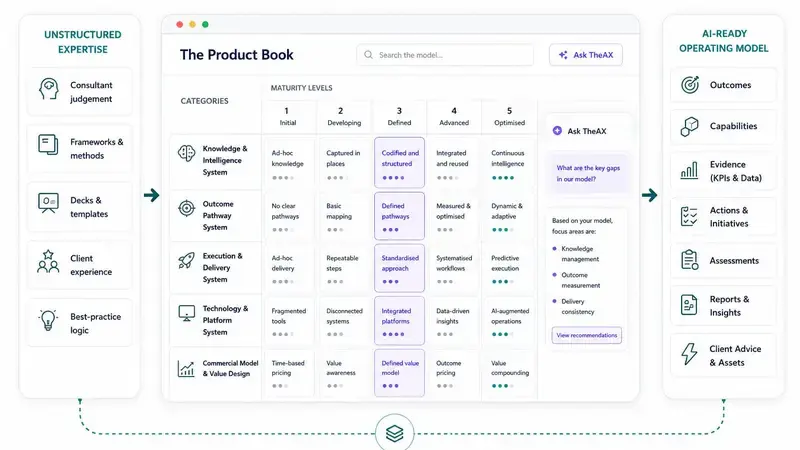
AX Product Book

Stored knowledge can be searched. Structured knowledge can be run.

This is the hard part, and TheAX does most of it. Guided workflows and AI draw the outcomes, capabilities, evidence standards, diagnostic logic and advice out of your senior people, draft the structure and hand it back for correction - nobody has to sit down and write a manual. What comes out is held as a Consulting Atomic Model, and that structure is why AI can act on your expertise later rather than guess at it. One book then serves unlimited engagements, so taking on more work stops meaning hiring more senior people.
How the evidence gets collected
Part 02

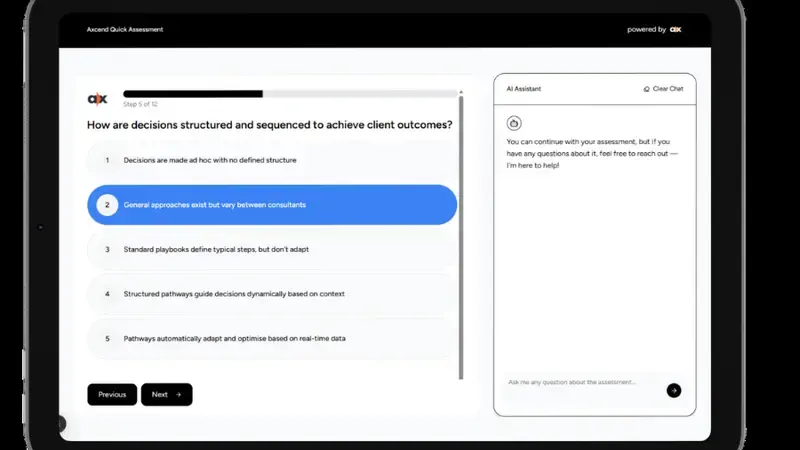
AX Assessments

Asking is easy. Asking the same way every time is the hard part.

Instruments generated from the book in minutes, so every engagement collects the same evidence to the same standard - whether a bot, a consultant or the client gathers it. The same model runs at three depths: a published lead magnet, a stakeholder questionnaire, a full triangulated baseline. A prospect who fills in the lead magnet is already on the scale you will assess them against.

The assessment and diagnostic engine
Part 03

AXAT

A diagnostic without evidence is an opinion.

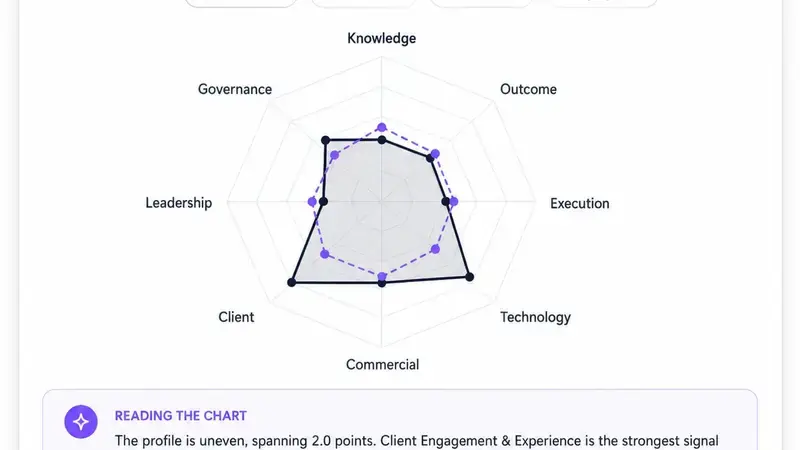
AX Assessment Triangulation. It takes your expertise and the data gathered from client interviews and returns repeatable diagnostic insight, root cause analysis and prioritised, targeted improvement advice. Senior-level analysis end to end in 30 minutes, run by any consultant. It gets there by measuring capability - the missing link between the work you do and the outcome the client wants.

Learn more about AXAT →
Outcome pathway KPI tracking
Part 04

Outcome Pathways

An assessment is a moment. A pathway is an engagement.

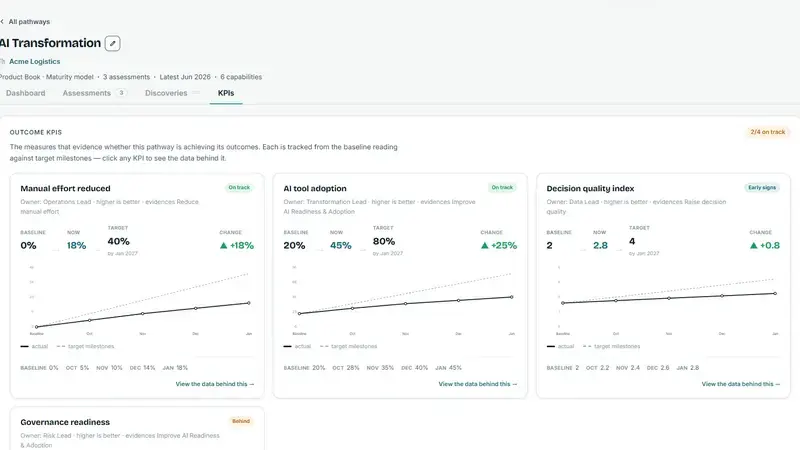
Pathways turn a one-off diagnostic into an ongoing, data-led engagement aimed at the outcome the client actually wants. The same assessment re-runs on the same scale as the programme moves, the client’s own KPIs track against a baseline and a target, and the advice adapts as their position changes. Capability uplift and KPI movement together are what evidence the outcome - the difference between telling a client it worked and showing them.

What the client sees
Part 05

AX Portals

Insight that arrives once is an event. Insight that stays is a relationship.

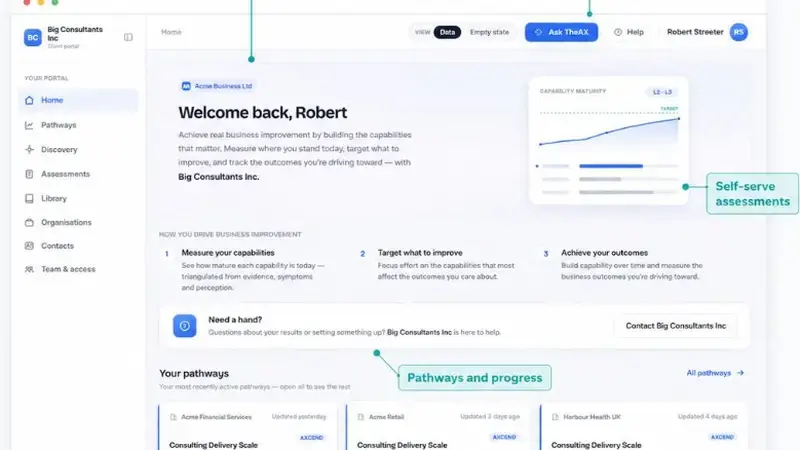
A workspace in your brand where the client sees their position, their pathway and their movement - and the account keeps working between engagements. The assistant inside it answers only from your model and their data. Nothing else, and nothing invented.

What you learn across every client
Part 06

AX Assessment Intelligence

You have run the assessment a hundred times. You have never seen the hundred together.

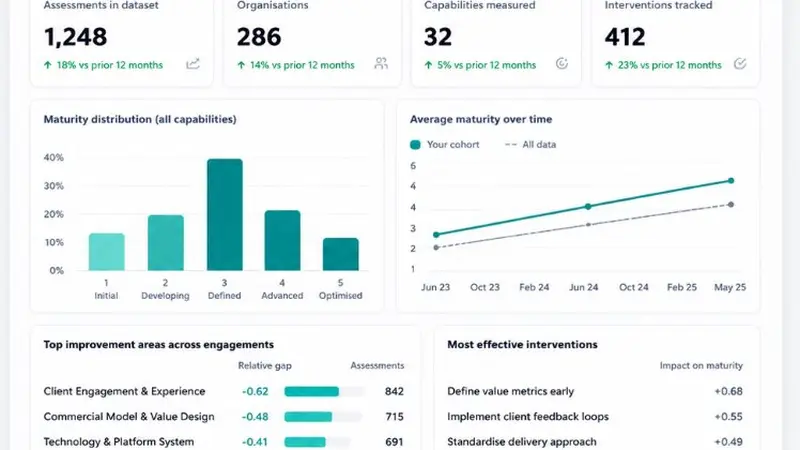
Benchmarks, recurring gaps and patterns across your whole client base - the insight that tells you what to build and sell next. When a client asks how they compare with firms like them, you answer with a number instead of an impression.

What comes out

One collection in. An evidenced diagnosis, the advice, and the outputs.

One set of data produces everything downstream, because it arrives structured against a model that holds your firm’s expertise. Nothing here comes from a prompt a consultant has to write.

One dataset in
PerceptionEvidence & artefactsSymptomsOpen textOutcome KPIsClient context
The diagnosticMore than a number. An evidenced position.

Every capability scored, with the evidence that set the level named and confidence reported separately - plus the root cause beneath the symptoms, and the client placed on the same scale as every other. Where confidence is low, the platform names what would raise it.

The adviceTargeted improvements, ready for the client.

Specific actions drawn from the guidance your firm authored, aimed at the capabilities actually constraining the outcome and sequenced against this client’s maturity. Nothing reaches the client without a consultant’s approval.

The outputsReports generated, and data that travels.

Branded reports, roadmaps and board packs generated from the model rather than written up after it - plus structured export of everything underneath, so the analysis can continue in whatever your firm already runs on.

Governed AI

The AI assembles. The consultant decides.

Programmatic where it has to be accurate. AI where it has to be communicated. Scoring, evidence binding and confidence are deterministic - the same inputs give the same answer every time. AI drafts the language around them.

Your expertise underneath

The advice is grounded in your model and your maturity bands - knowledge you can view, edit and audit. Not a black box, and not a public chatbot.

Judgement stays with the consultant

Scoring, recommendations and every output are reviewed before anything reaches a client. The system supports judgement rather than replacing it.

Traceable to the evidence

Every score links back to the perception, evidence and symptoms behind it, with the lens that set the level named - so a client can see why a recommendation exists.

A use of AI you and your client can both stand behind.

What it's really for

Everything above exists to change what you can sell

Once the capability is measured, tied to the outcome, and the movement is tracked, three commercial models open up: outcome-based engagements, subscription services, and evidence-led account growth.

You don't need a new business model. You need to be able to prove things - and then the new business model is available to you.

See what this unlocksBook a 15-min chat