Most consultancy leaders reach a point where Productisation feels like the answer.
They have been running on senior expertise, bespoke delivery, and relationships holding everything together. The business grows, but so does the pressure. More clients means more senior people, more complexity, more risk. So, they systematise what they can. They package the offers. Codify the IP. Create frameworks and diagnostics and defined scopes. Build something repeatable.
And for a while, it works.
Delivery becomes more consistent. Sales gets easier. New consultants can be onboarded faster. The firm starts to look and feel more scalable.
Then the plateau arrives.
Not suddenly. Gradually. The senior bottlenecks return. Delivery quality still depends on who is assigned. Clients ask for measurable outcomes, but the firm still sells effort. The business has better packaging, but the same underlying constraint.
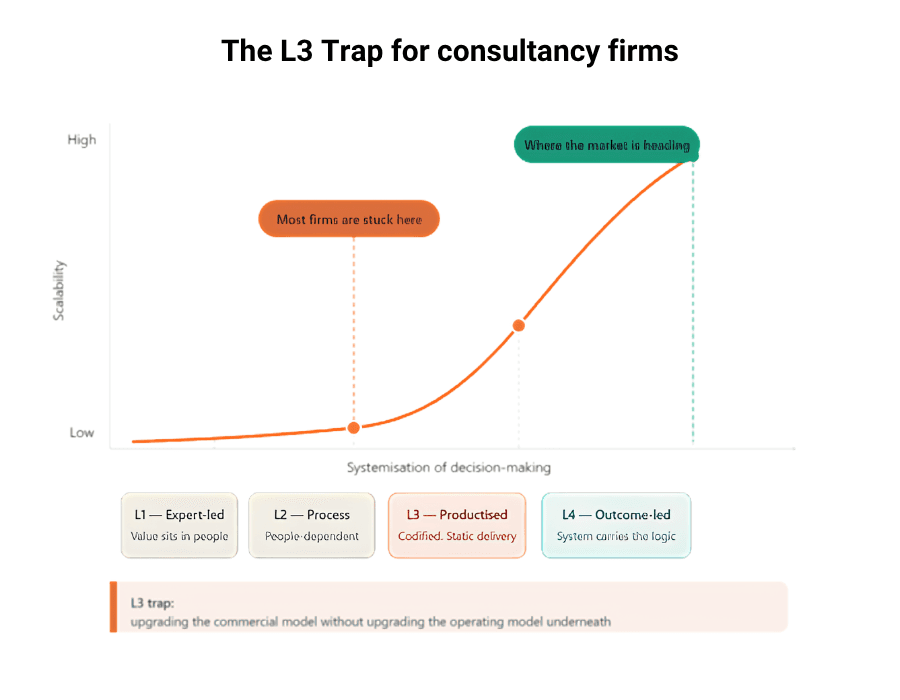
This is the L3 trap, and it catches firms that treat Productisation as the destination rather than the foundation.
In an AI world, Productisation should not be seen as the destination. But without it, you cannot reach the destination. Understanding why that distinction matters, and what the real destination should be, is what this piece is about.
What Productisation actually gives you
Let’s be direct about the value first, because it is real.
A productised consultancy can offer clients clearer propositions. It can define what is included and what is not. It can price with more confidence, onboard consultants faster, and reduce the variation in what clients receive. It starts to accumulate reusable intellectual property rather than losing it into slide decks and individual memories. And it creates the first signs of leverage: the firm stops reinventing every engagement from scratch.
For a consultancy that has been running on pure expertise, that is a significant shift. The business becomes easier to explain, easier to sell, and easier to run.
But here is what Productisation does not do: it does not change what is powering delivery underneath.
A productised offer can still be almost entirely manual at its core. The diagnostic may be standardised. The scope may be defined. The deliverable may look consistent. But the real work still sits inside experienced people: deciding what the diagnostic actually means, determining which issue matters most, sequencing what should happen next, judging whether progress is real.
The offer has been productised. The delivery logic has not.
And when that is the case, the ceiling has not moved. More clients still require more senior attention. More work still creates more complexity. Growth still pushes cost upward. The firm has become more efficient, but not more scalable.
Why the ceiling exists where it does
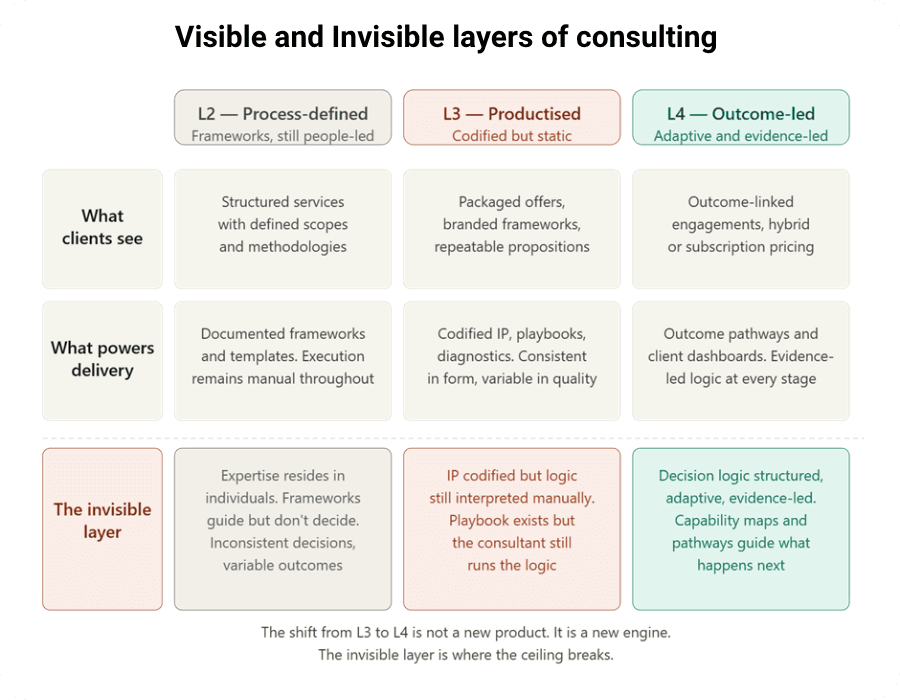
Most consultancies productise the visible layer: the things clients see. The proposition. The scope. The diagnostic. The report. The commercial model.
This is smart. These things matter. They help clients understand and buy the value.
But scalability does not live in the visible layer. It lives in the invisible one: how the root cause is actually diagnosed, how priorities are selected, how actions are sequenced, how progress is evidenced, how advice adapts when the situation changes, and how learning compounds across engagements.
In most productised firms, that invisible layer still sits entirely in people. In judgement. In pattern recognition. In the senior consultant who knows what the client really needs even when the methodology does not say it clearly.
This is not a failure of Productisation. It is the natural limit of it. Productisation packages expertise. It does not automatically externalise the decision logic that makes that expertise valuable.
That is the distinction that matters for where consulting is heading.
What modern Productisation has to do differently
AI has not introduced Productisation to consulting. Consulting was already moving in that direction, through frameworks, diagnostics, maturity models, playbooks, and benchmarking approaches. The direction was clear long before large language models arrived.
What AI has changed is the depth of what is possible.
The old version of Productisation created static assets. A fixed questionnaire. A standard output. A defined playbook. These improved efficiency but did not fundamentally change the model: the consultant still interpreted the results and translated them into recommendations.
Modern Productisation has to go further. It must structure the knowledge that sits behind the offer. The knowledge that previously could be delivered manually by consultants, and that has meant up until now that consultancy has been unscalable without headcount.
That means defining the relationships between outcomes, capabilities, diagnostic questions, symptoms, evidence, actions, KPIs, and progression logic. Not as documentation (a documented methodology is still static unless it can guide decisions and improve through use) but as structured decision assets enabled with AI: the underlying logic that explains not just what the firm knows, but how that knowledge connects to what the client should do next.
This changes the question Productisation is trying to answer.
The old question was: How do we package what we know?
The better question is: How does what we know help someone decide what to do next?
That shift, from packaging knowledge to structuring judgement, is where Productisation starts to become genuinely useful for AI, and where it starts to become the foundation for something larger.
Because AI does not solve weak consulting logic. If the expertise is fragmented or poorly structured, AI produces more output, more apparent confidence, and faster confusion.
But when expertise is structured, when the relationships between outcomes, capabilities, actions, and evidence have been made explicit, AI becomes a genuine amplifier. It can apply the logic, support diagnosis, guide next steps, capture evidence, and improve consistency at a scale no individual consultant can match.
Productisation done properly creates the structured knowledge base that makes that possible.
The L3 trap and why it catches so many firms
There is a moment in most Productisation journeys that feels like a breakthrough. The firm has packaged its expertise, codified its IP, and created repeatable offers. It looks more scalable. It may start introducing subscription-style services, retained advisory, or even outcome-linked pricing.
This is exactly when the risk is highest.
Upgrading the commercial model before upgrading the operating model creates a promise the delivery system cannot yet keep. The proposition changes. The engine stays the same. And when the same constraints return, they return with more commercial exposure attached to them: margin pressure, senior bottlenecks, inconsistent delivery, individual dependency, difficulty evidencing outcomes.
The L3 trap is not about having productised services. It is about believing the visible layer and the invisible layer have both changed, when only one has.
The move from L3 to L4 is not a better product. It is a new engine: one where decision-making is systemised, evidence-led, and adaptive, where the invisible layer has genuinely changed, not just been packaged more neatly.
What the foundation enables
Productisation sits at the base of a progression that most consultancies have not yet fully mapped.
Structured expertise enables decision logic. Decision logic enables Outcome Pathways: structured routes from a client’s current state to a defined outcome, specifying what should happen next, in what sequence, and with what evidence.
Outcome Pathways enable a Consulting Operating System: the integrated layer through which knowledge, delivery, client engagement, and measurement work together. And that, in the future, will enable Consultancy-as-a-System: the point where the model genuinely compounds, where each engagement makes the next one better, and where value scales without headcount scaling with it.
Each stage depends on the one before it. You cannot systemise what has not been structured. You cannot build Outcome Pathways without structured decision logic. You cannot operate a compounding system without the pathways to run through it.
This is why Productisation matters, not because it is sufficient, but because it is the entry point to everything that follows.
The firms that stop at Productisation will find themselves with cleaner offers and the same underlying constraint. The firms that treat Productisation as the first step in a bigger shift will use it to build something the market is increasingly demanding: a consulting model that can produce measurable outcomes at scale, adapt as evidence changes, and grow without adding headcount in direct proportion.
That model starts with structured expertise.
It does not end there.
Next in this series
Blog 4: Outcome-Led Consulting
Shift from recommendations to measurable improvement.