The TheAX Engine

Most maturity assessments measure opinion. The TheAX Engine measures the capability to deliver the outcome.

The engine - the Atomic Model and AXATworking together - enables something that wasn't possible before: converting the invisible layer, what lives in your consultants' heads, into repeatable, robust and defendable assessments. Fast to execute, they baseline capabilities and KPIs, deliver accurate diagnostics, and generate targeted advice and guidance for consultants and clients alike.

This walkthrough shows how it works, using a simple worked example - one inspector, one fictional restaurant, three lenses, one honest verdict.

The story at a glance

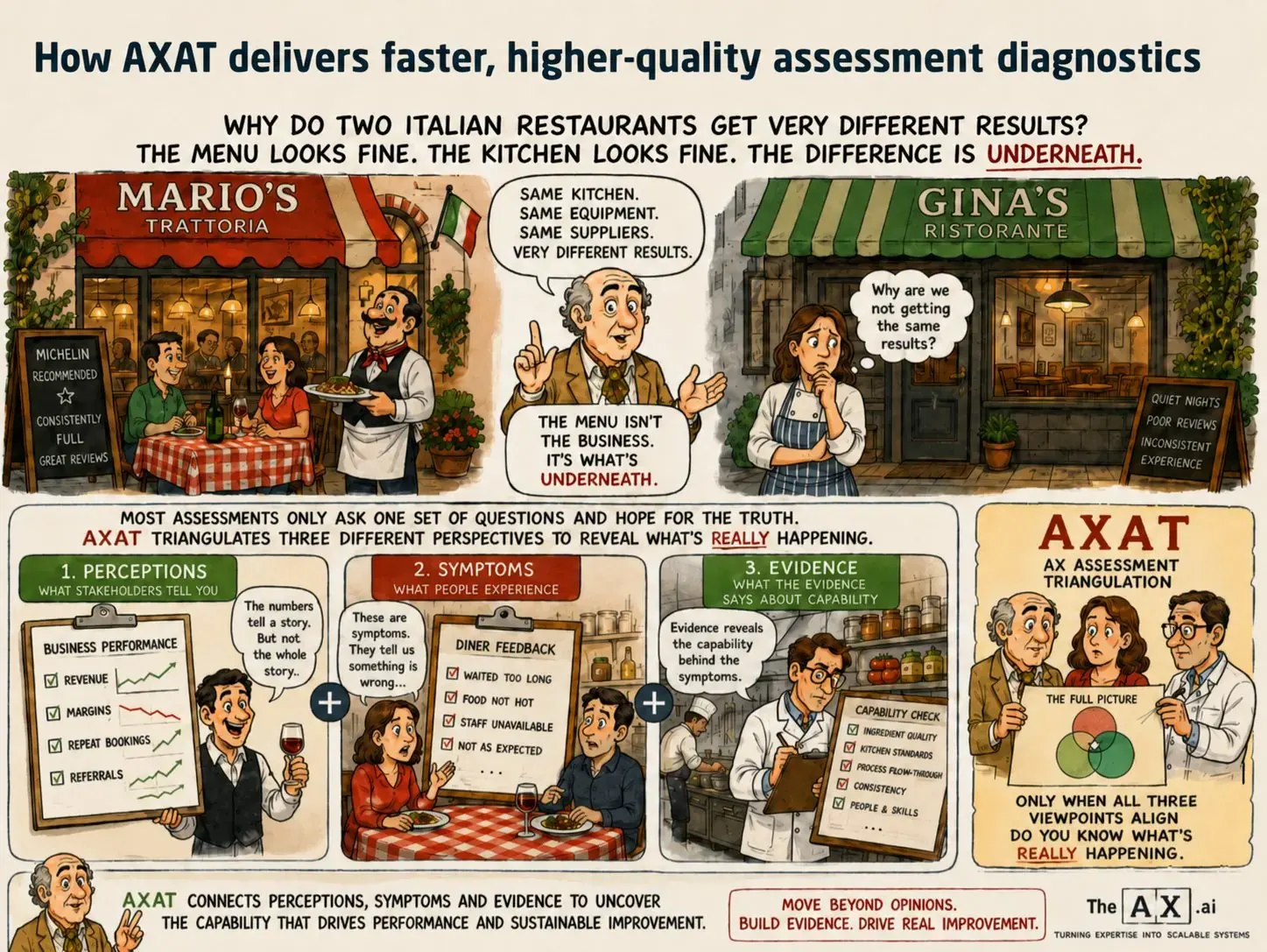
The whole walkthrough in one picture - two restaurants that look the same on the surface, three lenses, and the difference that lives underneath.

Illustrated overview: Mario's Trattoria is busy with great reviews while Gina's Ristorante next door has quiet nights and poor reviews despite the same kitchen, equipment and suppliers - the difference is underneath. AXAT triangulates three perspectives - perceptions (what stakeholders tell you), symptoms (what people experience) and evidence (what the evidence says about capability) - and only when all three align do you know what's really happening.

Why a new engine

Maturity models earned their place. Then two problems caught up with them.

For decades, maturity models have given consultants a fast, repeatable way to assess a business and package the advice that follows - turning a vague "how good are we?" into a level, a benchmark and a roadmap. That is genuinely useful, and it is why they have endured.

But for all their benefits, there are real problems we think can be solved. That is why we built AXAT - AX Assessment Triangulation: an algorithm that, combined with the data in your TheAX Consultancy Atomic Model and applied AI, elevates the maturity model from a good idea into a genuinely powerful and robust one.

Problem one · trust

The score rests on opinion

A workshop, a questionnaire, a consultant's read. Self-reported, hard to compare between businesses, easy to game. Artefacts get mistaken for ability, so a business scores well on paper and still cannot deliver. It looks rigorous. Often it is not.

Problem two · cost

Credible depth is expensive

A credible model is difficult and time-consuming to build, keep current, and analyse. It brings consistency at the price of flexibility - a fixed ladder that suits some clients and forces others - and turning the output into real advice still takes a consultant's hours.

AXAT answers the first

It scores each capability through three independent lenses at once - what people believe, what the evidence proves, and what the symptoms reveal - and lets the hardest truth win. Evidence sets the floor, real symptoms cap it, opinion only fills a genuine gap. Where the three disagree, it says so instead of averaging the disagreement away. That is how it catches what paper-based models miss: strong artefacts hiding a capability no one actually operates.

TheAX answers the second

What used to make this depth impractical - building a defensible standard, gathering the evidence, collecting honest signal across an organisation - is now AI-enabled. The platform curates the knowledge that sets the standard, collects all three lenses at scale, and runs the AXAT engine to corroborate them. The same assessment, delivered the same way every time - a diagnosis that holds up under challenge, not another deck of self-graded scores.

The worked example

The inspection of Chef Mario's Trattoria

Mario wants a 4-star plaque for his window. You can't just take his word that his restaurant meets the standard - so how would you audit it, and decide on the award?

A deliberately simplified, fictional illustration - three checks, six diners - chosen to make the mechanics visible. A real AXAT assessment goes far deeper.
Option 1 · a good inspector

Reads it in an afternoon

But that skill is slow, costly, and locked in one person's head. Standards vary from one inspector to another - and it does not scale.

Option 2 · hand it to an AI

Fast, but gullible

You get speed - but it would take Mario's word for it, average in the happy diners, and sign off a business that is not really there.

Option 3 · AXAT

The consultant's discipline, as an engine

Check the claim, test it against the evidence and the room, and let the worst lens win. Audit-level rigour, substantiated findings - fast, and still honest.

The read, lens by lens

So instead of trusting the feel of the room, you measure

Every check turns into a score from 1 to 5 - nothing in place scores 1, everything in place scores 5, and part-way lands in between. Three lenses, taken independently.

Lens 1 · Perception - what Mario says

The claim, written down and believed later

You ask Mario to rate his own kitchen against the standard. It is a data point, not a verdict - owners over-rate and under-rate for all kinds of reasons, so you record it and test it against the other two lenses.

Perception2.0 / 5
Lens 2 · Evidence - what the kitchen proves

Three things a real 4-star kitchen must have

You score how complete each one is. Empty is missing, half is partial, full is in place. Mario's kitchen: written recipes and prep system - missing. Food-safety logs - started, half-completed for weeks. A trained second chef - none.

Written recipes & prep systemmissing
Food-safety logspartial
Trained second chefmissing
Evidence1.67 / 5
Lens 3 · Symptoms - what the diners feel

The room is… mostly happy

Six diners, tonight. Four are enjoying themselves; two have hit the tell-tale problems - the wait, the inconsistency. Mostly a happy room. So why are diners happy despite an empty kitchen? Because Mario, the one hero chef, holds it together every night. The day he is sick or poached, those happy diners turn furious overnight.

Symptoms3.44 / 5

Triangulate

Let the hardest truth win

Three lenses, three different answers. An average would split the difference and hand Mario his plaque. AXAT does not average - evidence sets the floor, symptoms cap it, and the claim is tested against both.

Perception - the claim2.0
Evidence - the kitchen1.67
← the floor. The score cannot rise above what the evidence proves.
Symptoms - the diners3.44

Verdict: no plaque. Happy diners cannot rescue a kitchen that does not exist. The capability score sits at the evidence floor - mature-looking room, hollow kitchen - and the assessment says exactly why, check by check.

This is the discipline in one sentence: do not average away the thing that can fail.

The mirror case

Next door: Gina - the built kitchen the diners can't feel

Gina has the recipe book, the certificates, the trained staff. On paper her kitchen scores high. But her diners are in real pain - slow, inconsistent, badly served. The paperwork is real. The cooking and service are not.

This is the case the whole method exists to catch. Evidence alone would have waved Gina through. Only the diners reveal that the built kitchen is not actually working - so the symptoms drag the score down to 2.33. Mario fails because nothing is built. Gina fails because what is built does not land.

Rows: diners happy (top) → diners unhappy (bottom) · Columns: kitchen not built (left) → kitchen built (right)

Chef Mario's TrattoriaThe hero-chef trap
Perception2.0
Evidence · the floor1.67
Symptoms3.44
Capability score 1.7 - the kitchen is the floor

The advice: get it out of one head. Write the recipes down, train a second chef, put prep on a system. Building the kitchen is what lifts the score - and it protects the room the day the hero is gone.

Gina's CucinaThe paper-maturity trap
Perception4.0
Evidence4.33
Symptoms · the floor2.33
Capability score 2.3 - the diners are the floor

The advice:the manuals already exist - don't write more. Get them used: coach the team, close the gap between the written process and the real one. Only better service lifts the score. More paperwork would not move it.

The owner's claim sits on each card but never wins. The score is always the lower of kitchen and diners - and because a different lens is the floor in each case, the advice flips too. Mario has to build what is missing. Gina has to make what she already built actually work. Two different failures, one tool that catches both.

And every score carries a trust label

Solid - lean on itFlagged - lean lightly, re-check booked

Two things decide it: how far the three readings agree with each other, and how much of the panel actually answered. A flagged score still stands - the label never moves the number. It only tells you how hard to lean.

The engine - the other element

The Atomic Model: how advice knows what it's for

AXAT is the algorithms; the Atomic Model of Consulting is the structure they run on - your expertise held as a relational data structure, not a framework we impose. Outcomes, KPIs, capabilities, actions and evidence are connected as data, so the system can reason across them the way your best consultant does.

The right questions, asked and answered by the platform as a consultant would:

  • Where do stakeholders think they are - and does the evidence agree?
  • What are the root causes of the symptoms?
  • Which capabilities must improve to deliver the desired outcome?
  • What are the next best actions to take?
  • Is change delivering measurable outcomes - and what's the evidence?

Because the model is connected end to end, the system reasons backwards from the outcome: which capabilities drive it, which are constraining it, and which actions strengthen them. That's why the advice is specific to this client and this outcome - substantiated inputs and context, not data volume.

In the product

Everything you just did by hand, the platform runs end to end

And it gathers most of the data itself. Automated agents collect a full assessment in hours, not weeks, at a fraction of the cost. Where a capability needs more depth, targeted consultant interviews are layered in - automation for breadth and speed, expert judgement where it counts.

Curating expertise

It starts with your IP: the platform's AI workflows help your consultants curate their expertise into a Product Book, structured in the Atomic Model - so the engine has your standard to score against. Captured once, reused on every run.

Repeatable products

From the Product Book, TheAX builds the repeatable products: assessments, questionnaires, workflows and delivery assets - built once, branded as yours, run the same way every time. A new client means running the product again, not rebuilding the workshop.

Data gathering

Structured maturity questions collected by an AI-guided agent, with an assistant on hand for whoever is answering - fast, low-cost, and consistent across every run.

The scoring view

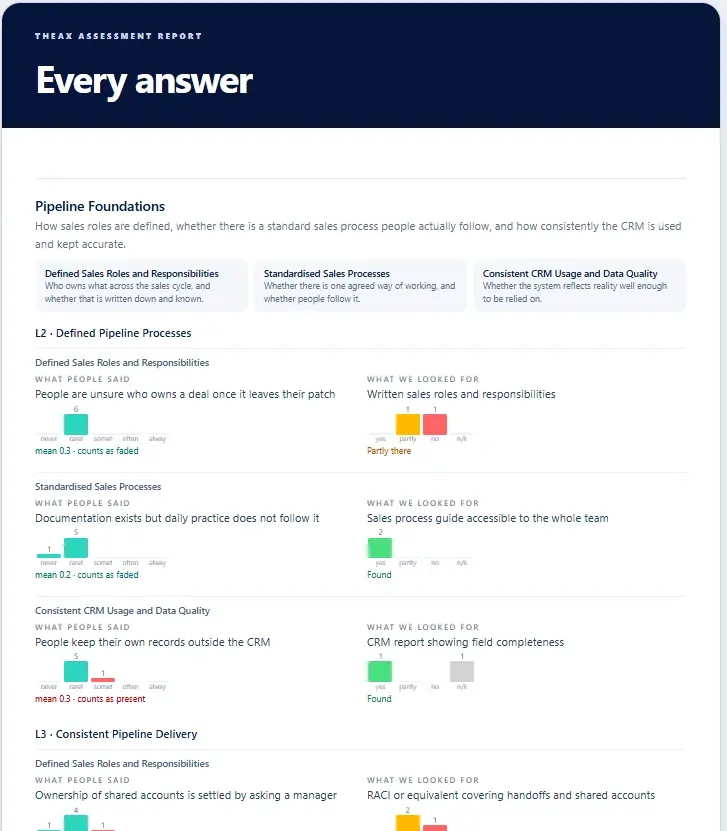
Evidence caps the rating, symptoms sit above it, and Perception - the claim - is held separate and tested against the other two. the very same assessment as Mario's, at platform scale, across a whole capability model.

Assessment intelligence

Every run also feeds a shared intelligence layer. Aggregate across your client base and you get consultant-grade benchmarks, insight you would never see one engagement at a time, and early warning of where a problem shared by many clients is really an opportunity - a new service, offer or campaign aimed squarely at what your market needs.

And AXAT is easy to put to work: an expert in any field can set up their own assessment in TheAX and have it ready to deliver as a product in a single afternoon.

A happy room can hide a failing kitchen - and a glowing report can hide a failing business.

AXAT corroborates perception, evidence and symptoms into one rating you can defend - and TheAX lets any expert build it and deliver it as a product in an afternoon. See it on your own capability model.