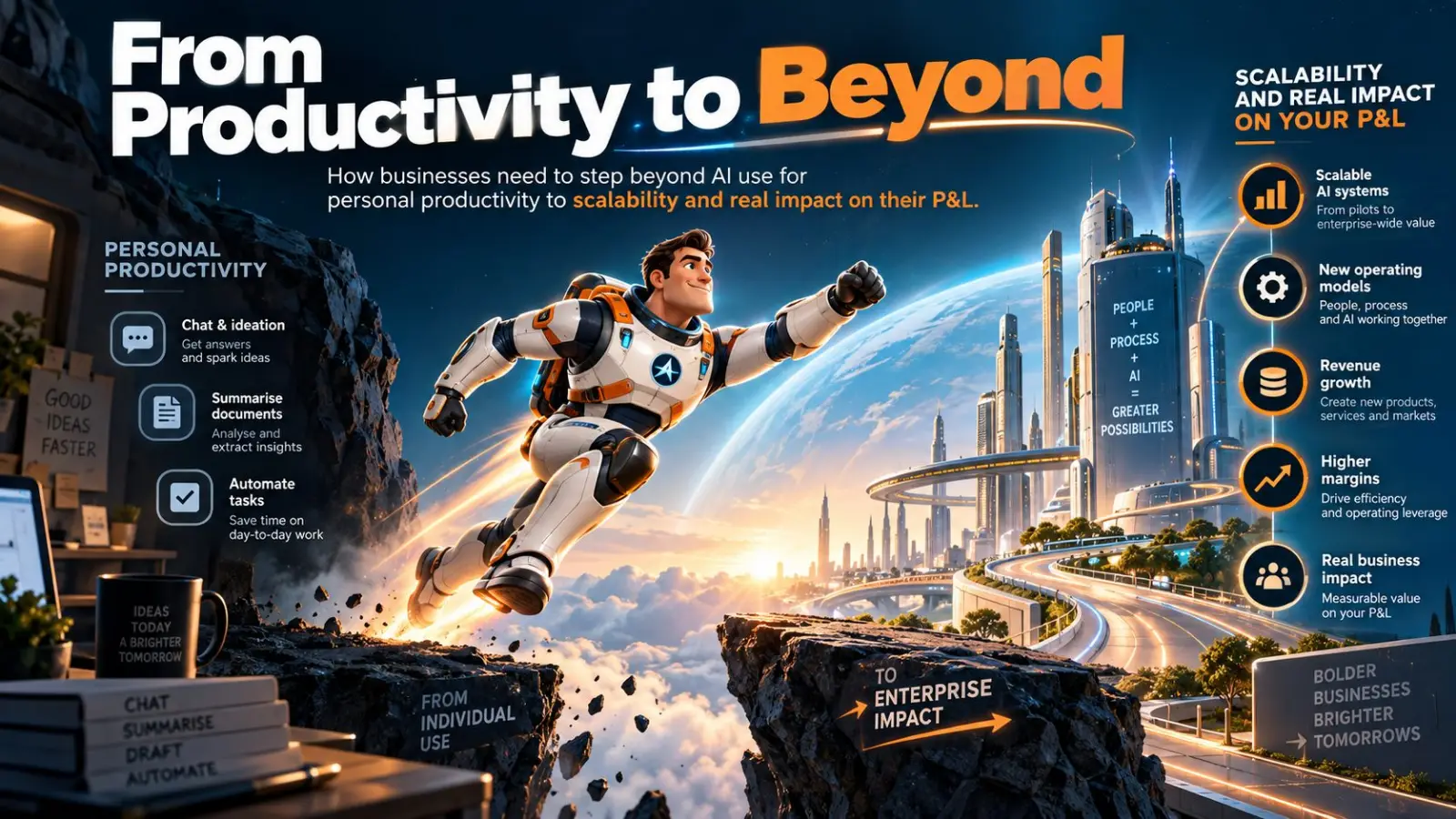
Every engagement I have run across a thirty-year career — from business analyst to Head of Consultancy, and a lot of transformation in between — has had a visible top and a visible bottom. Your experience, and that of every other change professional or advisor, is probably the same.
At the top is the outcome the client wants and is paying for. It’s named in the proposal and the scope document, restated at kick-off, and argued over at the post-project review and again at renewal. At the bottom is the work you delivered — the workshops, the target operating model, the new process, the trained team. All of it documented, invoiced and reported on.
Between them sits the layer that actually decides whether the one produces the other.
That layer is the capabilities the business must build and improve in order to hit the outcome. This is not some optional element in a change programme; it is the only way an improved outcome can ever be delivered. An outcome cannot change unless the organisation’s capability to produce it changes — otherwise you are doing what you were already doing and expecting a different result. And the improvement in any capability has to be embedded, or it decays the moment the programme ends.
A simple equation, with proven connections. So if Drucker was right that what gets measured gets managed, why does almost nobody measure it on a change programme?
That’s the missing link.
Why it matters more than it sounds
In most change programmes two things go unmeasured: the capability layer itself, and the reasoning a consultant uses to read it. The first is assumed. The second lives in a consultant’s head.
Five consequences follow — and the last one isn’t caused by the gap at all. It’s caused by the answer the profession is currently reaching for in response to AI.
The work is guessed.Without a starting level for the capabilities that drive the outcome, or a target to reach, you intervene on judgement rather than through a repeatable, data-led process. And no two people hold the same judgement. Which lever to pull gets decided by whoever is in the room — experience, the loudest voice, whatever the client has already concluded, or someone asking an LLM. Sometimes that’s right. You have no way of knowing when it isn’t, or which of your effort was necessary and which was wasted.
The work is unprovable.No baseline, no measurable hypothesis, no tracked movement — so return on investment becomes a story assembled afterwards. That makes outcome-based pricing dangerous to attempt, dents client confidence, and turns the follow-on into something you have to win rather than the natural next step.
The work is one-off.Led by individual judgement, the reasoning stays in someone’s head and the next engagement starts from zero. Project documentation may exist, but where it matters — in repeatable judgement — nothing compounds. And the firm’s IP walks out of the door with the consultant every Friday.
The firm doesn’t scale.When everything routes through the few who hold the judgement, capacity is capped at your seniors’ calendars and margin is capped with it. The firm grows by hiring more expensive people. We all know this; it’s how it has always been. What’s new is the response: use LLMs to make seniors faster and carry fewer juniors — the changing consultancy pyramid everyone is now discussing. But note what it doesn’t fix. Even with faster consultants, scalability is still restricted by headcount and by the availability of experienced seniors.
And the firm stops teaching. Here is the compounding problem. Juniors learned the craft by doing the groundwork, and that groundwork was how they became the seniors a firm needs in order to scale. It was never written down anywhere else. As AI absorbs it and seniors work faster without them, that route quietly closes. The firm gets faster this year, solving an immediate problem, and thinner every year after.
That is the argument for systemising the method that delivers the measurement and the next best steps, rather than simply accelerating the people who hold it today. Judgement captured as a model can be taught, delegated and improved. Judgement that exists only in a partner’s head can only be absorbed by someone sitting next to them — and increasingly, nobody is sitting there.
“We do measure capability. We use a maturity model.”
Many firms do, and they earned their place — a maturity structure has been the only repeatable way capability could be measured at all. But two problems caught up with them.
The score rests on opinion.A workshop, a questionnaire, a consultant’s read. A valuable conversation, but self-reported, hard to compare between businesses, and easy to game without the consultant time to verify what you’re being told. Artefacts get mistaken for ability, so a business scores well on paper and still can’t deliver. Your client knows it, which is why the uncomfortable finding is always the first one negotiated away.
Credible depth is expensive.A defensible model is slow and costly to build, slower to keep current, and buys consistency at the price of flexibility. Turning the output into real advice still takes a consultant’s hours, one client at a time — or it becomes pre-canned responses that only approximate what the advice should have been.
Neither is a reason to abandon maturity models; there is too much value in how they structure knowledge. Both are reasons to fix them.
What changes
At TheAX we have spent the last two years fixing those deficiencies, so that a maturity model becomes something considerably more useful. Two things, working together.
AXAT — the AX Assessment Triangulation method — answers the trust problem. It scores each capability in a model through three independent lenses at once: what people believe, what the evidence proves, and what the symptoms reveal. Then it lets the hardest truth win. Evidence sets the floor, so a score cannot rise above what the artefacts actually demonstrate. Real symptoms cap it, so a well-documented capability that nobody operates gets caught — that is an adoption problem, and it is exactly the kind that gets missed. The claim, drawn from a person’s perception of their organisation’s capabilities, is tested against both, and only fills a genuine gap where evidence and symptoms have not been collected.
Crucially, where the three disagree it says so, rather than averaging the disagreement between people and findings away. Don’t average away the thing that can fail.And every score carries a trust label, calculated through the AXAT algorithms — solid, or flagged — decided by how far the readings agree and how many of the assessment participants answered. A flagged score still stands. The label never moves the number; it tells the consultant where more work might be needed to resolve the uncertainty.
The Atomic Model answers the cost problem.Delivering AXAT starts with data structures — we call ours the Consulting Atomic Model, because of the way it organises and connects knowledge into logical groups of information. Your expertise is held as connected data rather than as a document: outcomes, the KPIs that evidence them, the capabilities that drive them, the actions that strengthen those capabilities, and the evidence that proves each one. Not a framework we impose. Your standard, curated once from your own senior people, and reused on every run.
The Atomic Model resolves the data problem; AI enables the creation and delivery of that model at machine pace. Which overcomes exactly what held traditional maturity models back — the time and cost to build them, maintain them, and deliver them.
Because the model is connected end to end, the system can reason backwards from the outcome: which capabilities drive it, which are constraining it, and which actions will strengthen them. Or forward from symptoms, to identify what causes of a poor outcome might be present. Or in any direction, answering connected questions from your firm’s own IP combined with the client’s context.
That’s why the advice is specific to this client and this outcome, rather than generic to the framework.
And it runs at scale
This is the part that was never available before.
An expert can read one business in an afternoon. None can read ten thousand. Automated agents in TheAX now collect a full assessment from multiple participants in minutes or hours rather than weeks, at a fraction of the cost, with targeted consultant interviews layered in where a capability needs real depth. Automation for breadth and speed; expert judgement where it counts.
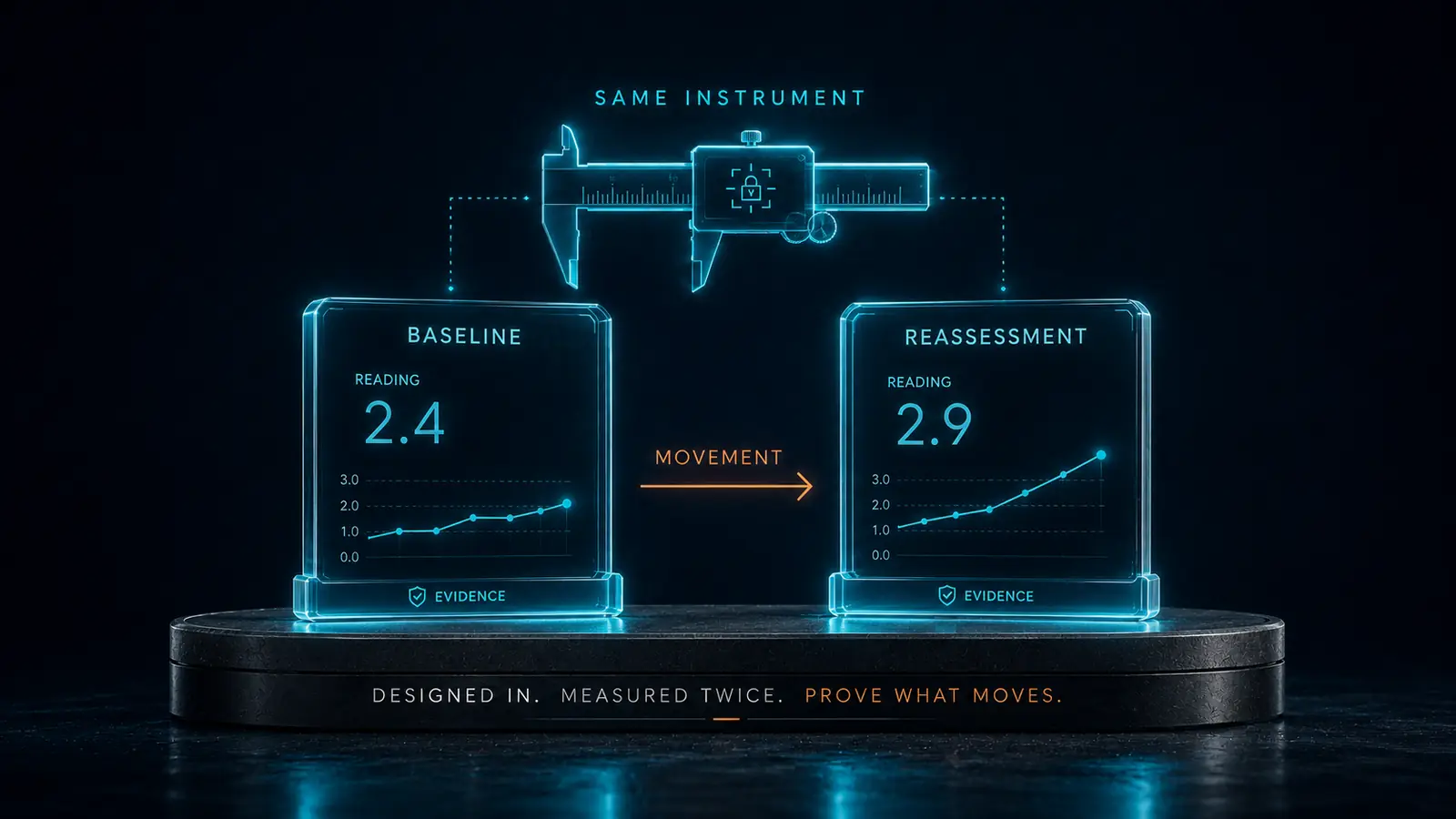
Capabilities and the outcome’s KPIs are both baselined at the start and re-read over time, so capability movement and business result sit on the same chart instead of being argued about separately. Each engagement records the hypothesis, the intervention and the result observed — predicted first, then confirmed by evidence. When the observed result matches the prediction, that is considerably more than attribution. And where it doesn’t, the delivery team finds out early that the hypothesis isn’t aligning with the evidence, and can adjust as they go rather than discovering it at the review.
The practical effect for a consultancy isn’t a better score. It’s that the diagnosis survives the room, including the part the client didn’t want to hear — and that you can do it across every client rather than only the ones your senior people have time for.
See it work
We’ve published the full walkthrough, using a deliberately simple example: one inspector, two restaurants next door to each other, three lenses, and two opposite failures that an average would have missed entirely.
It takes about five minutes, and it shows the mechanics rather than describing them.
AXAT Assessments are live in TheAX. If you’d like to see the engine in practice, book a 15-minute chat.