You go to a doctor. They ask how you've been feeling. Then they examine you. Then they send you for bloods.
Three instruments, deliberately different, and none of them trusted on its own. If your GP wrote a diagnosis on the strength of the first question and sent you home, you would find another GP - or end up a very sick patient on the wrong treatment.
Every serious diagnostic discipline works this way. An auditor asks management how the controls operate, then tests whether they did. An examiner doesn't ask a candidate how well they know the subject. A structural engineer doesn't ask the building.
So here is the question I have never had a good answer to.
Capability is the core of how any organisation delivers an outcome, which makes it central to every change programme - and it means every programme is, in effect, starting from a diagnosis. That diagnosis has money attached, and reputation attached, and a client will make decisions on the back of it.
So why does it so routinely rest on a single instrument? One set of questions, asked once, of people with an interest in the answer. I suspect we have all watched it happen.
What a good consultant already does
The honest answer is that most experienced consultants don't rely on one instrument. They already triangulate; they just do it invisibly.
Think about how you actually work when you have the time. You interview people, and you listen for what they believe about their own organisation. You ask for documents, and you notice which ones exist, which are half-finished, and which get produced with a slightly embarrassed apology. And you probe what's going wrong day to day - where things get stuck, what gets escalated, what the same three people keep firefighting. You might even have a checklist to work through.
Consciously or not, a good consultant is running three separate instruments. What people believe. What the artefacts prove. What the symptoms reveal.
You've been running them in parallel for years and reconciling them in your head. When a manager tells you their onboarding process is strong, and you can see the process document was last updated in 2021 and three teams have built their own workaround, you don't average those into "moderately strong". You conclude something specific: the process exists on paper, nobody follows it, and the real question is why.
That reconciliation is the expertise. It's also the part that is almost never written down - which is why it can't be delegated and can't be repeated reliably. And because all of it depends on your experience, your judgement and your available hours, it can't be done for eleven clients at once.
The problem with asking ten people
There's a second reason a single instrument fails, and it shows up the moment you scale beyond one interview.
Ask ten people to rate the same capability and you get ten answers. Any seasoned consultant knows that raises questions rather than settling them. But the default in almost every assessment tool on the market is to average them - and exactly the same thing happens when averaged interview findings get pasted into a prompt.
That instinct is imported from measurement, where it is correct. If you weigh something ten times on a noisy set of scales, averaging cancels the error, because the error is random and symmetrical.
Perception isn't like that. The variation isn't noise. It's structured, and it's structured by where someone sits.
Leadership tends to rate higher, because they can see the plan, the investment and the intent. The people delivering tend to rate lower, because they can see what happens when the plan meets reality. The person who says "honestly, we can't do this" is very often the one who has actually tried.
Average those together and you don't cancel an error. You suppress a signal. The number lands somewhere in the middle, where nobody in the organisation actually lives, and the most informative thing in the whole exercise - that belief about this capability breaks down at a specific level of the business - disappears into the arithmetic.
Corroboration is the alternative. Rather than blending the readings, you ask what each one is evidence of, and what it would take for it to be wrong. Which is neither quick nor easy while it relies on a consultant to work through it by hand.
The thing a single reading can never do
There's one more limitation, and it's the one I find most persuasive.
A single instrument cannot report its own confidence.
If you have one number, you have no way of knowing whether it is solid or shaky. It looks identical either way.
A capability where everyone agreed and the evidence was complete produces a 3. A capability where leadership said 4, the delivery team said 2, and half the panel didn't answer also produces a 3. Same digit, wildly different reliability, and nothing in the result tells you which one you are holding.
Three readings solve that as a side effect. If they converge, you can trust the answer. If they scatter, you can't - but you now know exactly where to go and look for more evidence.
What AXAT actually does with that
AXAT - the AX Assessment Triangulation method - takes those three instruments and applies them consistently, at machine speed from data gathering through to diagnosis, on every capability rather than only the ones a consultant had time for.
Evidence sets the floor. A capability cannot be scored above what it can demonstrate. Documents, artefacts and records are assessed for completeness, and that becomes the level below which the score cannot rise.
Symptoms cap it.What the organisation actually experiences day to day sets a ceiling. It doesn't matter how good the playbook is if nobody is following it.
The claim fills genuine gaps, and never wins on its own. Where evidence and symptoms have nothing to say, perception is used. Where they do, it is tested against them.
Disagreement is recorded, not resolved.Where the three don't line up, that is surfaced as a finding rather than smoothed into a number.
And every score carries a trust label. Solid or flagged, based on how far the readings agreed and how much of the panel responded. The label never changes the number. It tells you how hard to lean on it, and where a consultant should look harder.
Where it fits: the five moves
Triangulation is the second of five moves, and it only works because of the one before it.
00 · Curate. Your expertise is structured as a model an AI can actually work with - the outcomes you deliver, the KPIs that evidence them, the capabilities that drive them, the actions that strengthen those capabilities, and the evidence that proves each one. This happens once, to your firm, not once per client. Everything after it is only as good as this is.
01 · Assess. Perceptions, evidence and symptoms are collected against that model, by automated agents in hours rather than by consultants over weeks, with targeted interviews layered in where a capability needs real depth.
02 · Validate. The three lenses are triangulated. Floor, cap, corroboration, trust label. This is AXAT.
03 · Connect. The scored capabilities are linked to the outcome the client is actually paying for - which ones drive it, which are constraining it, and where the leverage sits. This is the move no other capability tool makes.
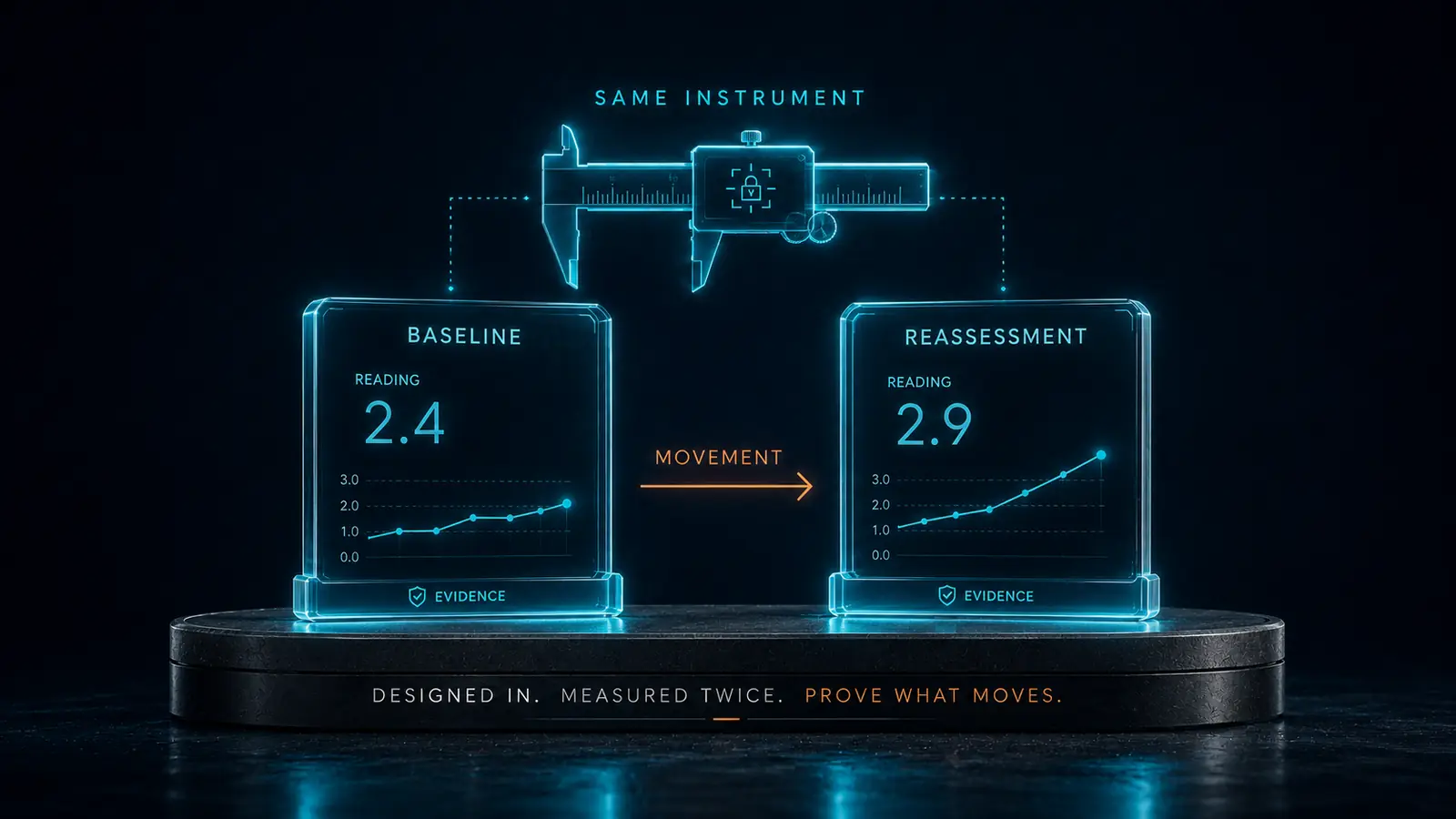
04 · Prove.Capabilities and the outcome's KPIs are baselined together and re-read over time. Each engagement records the hypothesis, the intervention and the result observed. Predicted first, then confirmed.
The short version
Nobody would accept a medical diagnosis based on how the patient said they felt. We accept the equivalent in capability assessment constantly - and then wonder why the score doesn't survive contact with a sceptical client, and why the actions that follow it don't always deliver the outcome.
One set of questions gives you one opinion. Three instruments, read independently and never averaged, give you something you can defend.
We've published the full walkthrough, using two restaurants next door to each other and two failures that an average would have missed entirely.
AXAT Assessments are live in TheAX. If you'd like to see the engine read one of your own outcomes, book a 15-minute chat.