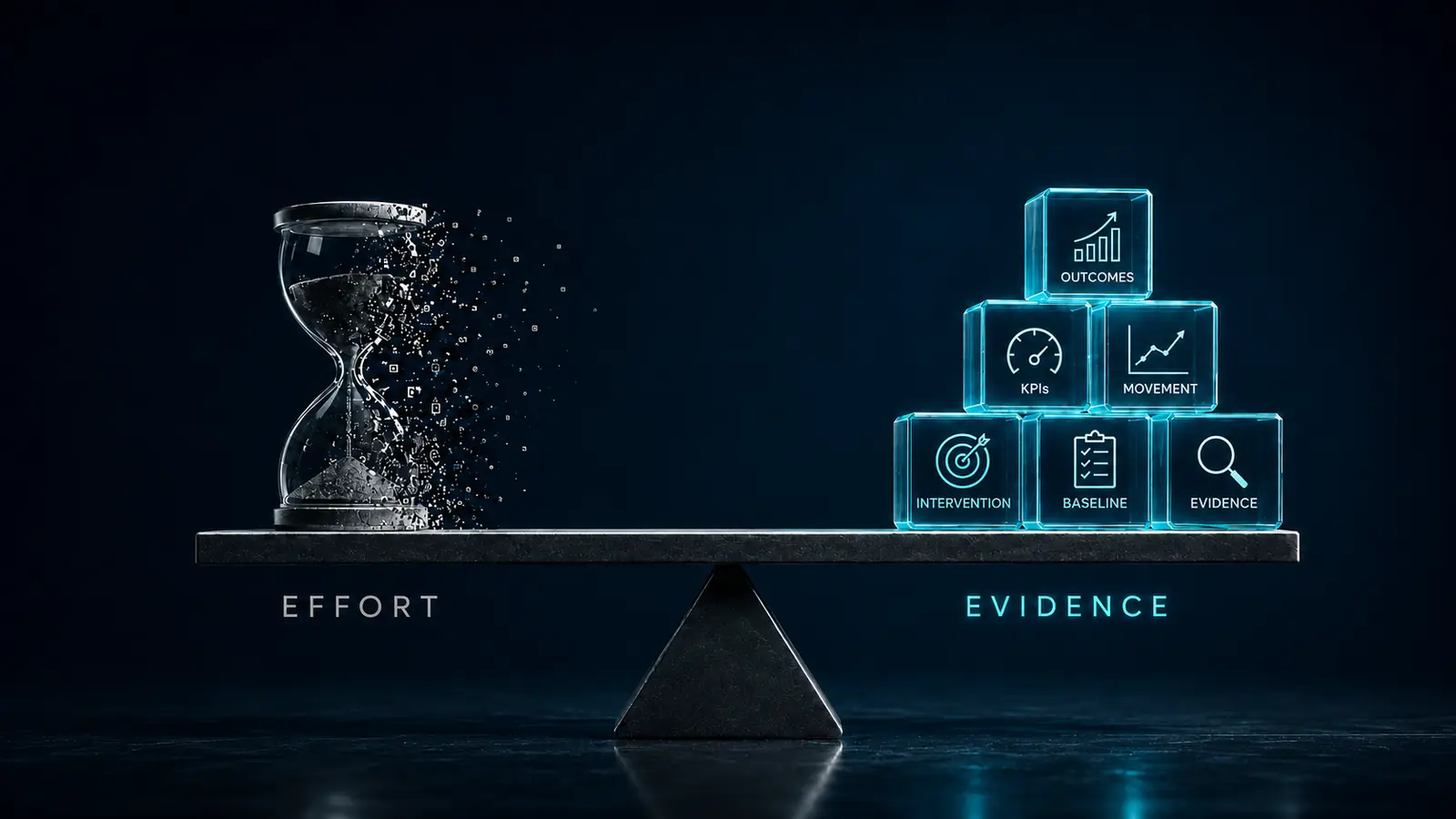
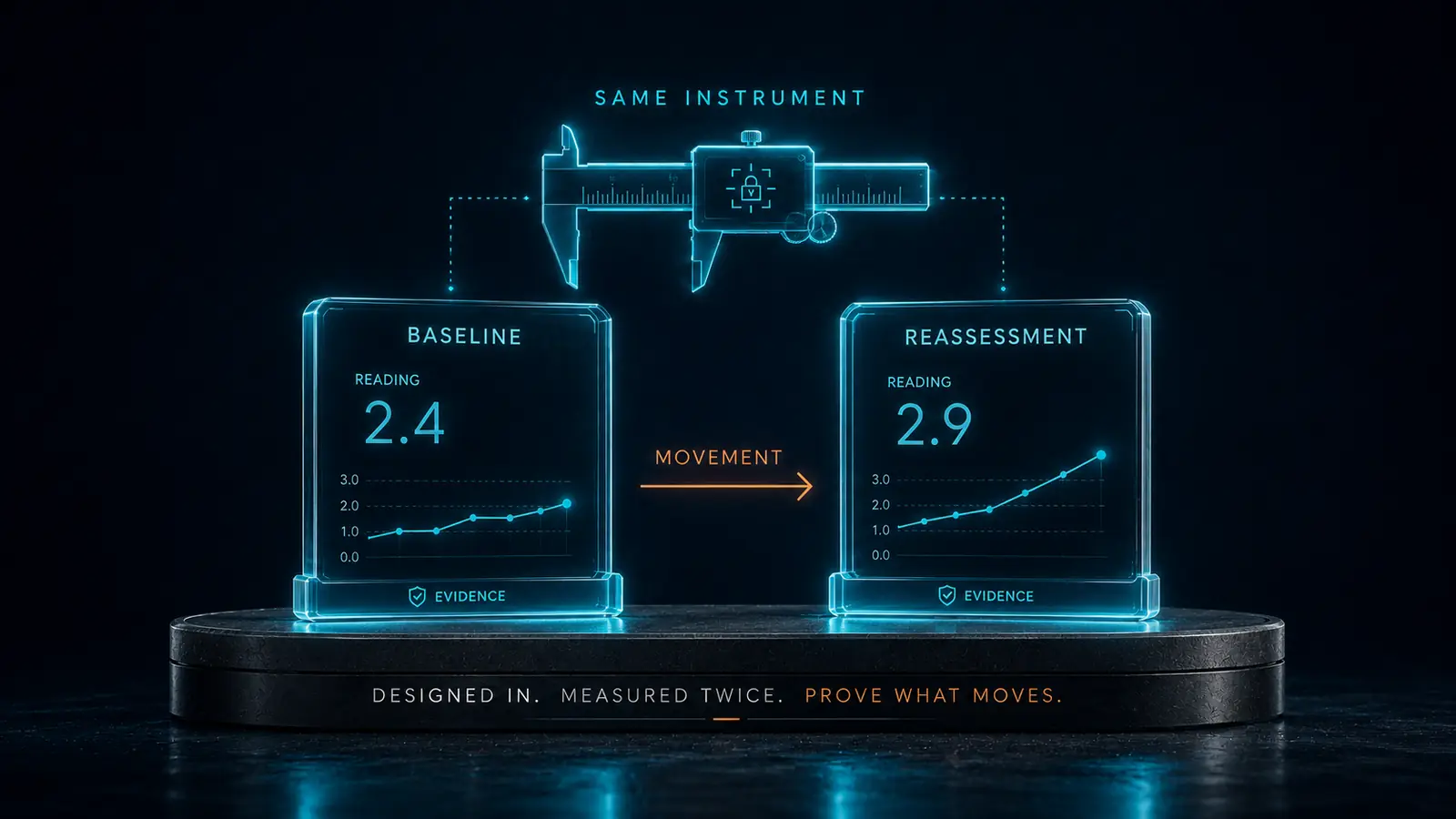
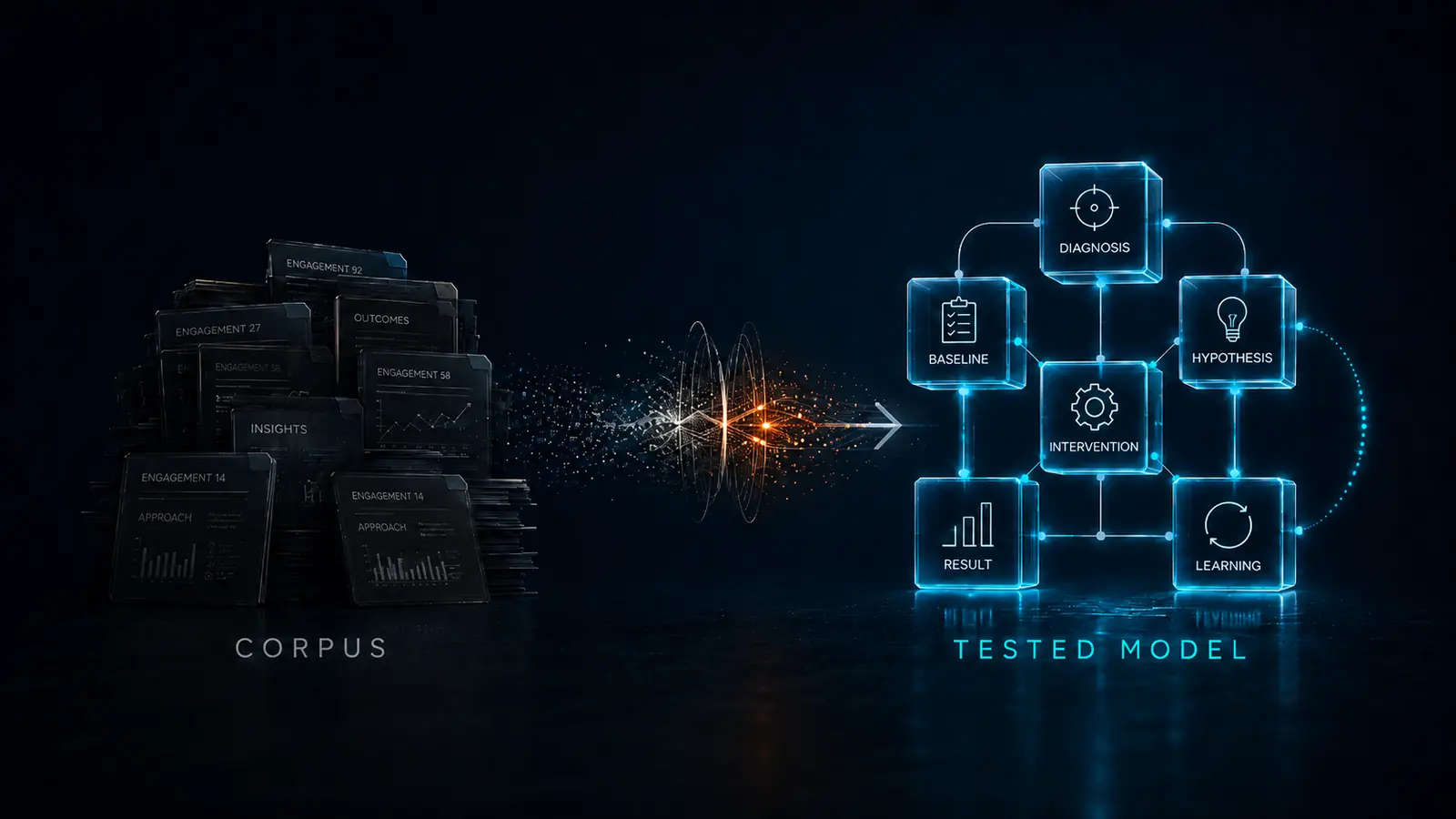
AI has changed the pace of how organisations operate.
Research, analysis, planning, and content creation have all become faster. And now, execution is set also to become faster in increasingly agentic organisations. Work that used to take days can now happen in minutes. Ideas can become plans almost instantly. Plans can become actions with far less friction than before.
In many ways, that is extraordinary. But speed is not the same as progress.
That distinction matters because the visible signs of productivity are becoming easier to create. More documents. More analysis. More recommendations. More campaigns. More workflows. More initiatives. From the outside, that can look like momentum. It can feel like progress.
But the real test for organisations is not whether more activity is happening.
The real test is whether better outcomes are being achieved.
And this is where I think the real AI story begins.
AI has accelerated action, but it has not automatically improved decision quality. In fact, in some cases it has increased the risk. If an organisation makes a strong decision, AI can help it move faster and scale that decision more effectively. But if an organisation makes a weak or wrong decision, AI can help it scale that too.
Faster execution works both ways.
That creates a new constraint for organisations, and for the consultancies that support them.
In an AI-speed world, decision quality becomes one of the most important determinants of outcomes.
When poor decisions scale faster
In a slower world, poor decisions had friction around them. Work took time. Coordination took time. Implementation took time. Communication took time.
That friction was inefficient, but it also created a form of protection. It gave people time to challenge assumptions, test direction, spot misalignment, and correct course before a decision had travelled too far through the organisation.
AI reduces that buffer.
A strategy can be drafted quickly. A plan can be produced quickly. A new process can be automated. A campaign can be launched. A workflow can be redesigned. A recommendation can be turned into action before the underlying assumptions have been properly tested.
That is not inherently bad. In the right context, it is powerful. But without the right structure, it creates a different kind of risk.
The issue is no longer only that organisations might make poor decisions. It is that poor decisions can now be implemented faster, scaled further, and embedded more deeply before there is enough evidence to know whether they were right.
AI-generated outputs can also feel persuasive. They are often polished, confident, and plausible. They can make incomplete thinking look structured and weak assumptions look credible. They can create the feeling that a decision has been properly reasoned through, when in reality it may only have been expressed well.
This is why activity is becoming a less reliable signal of progress.
The question is not: are we doing more?
The question is: are we doing the right things, in the right order, with enough evidence to know whether they are working?
The new dilemma for organisations
The answer is not to slow everything down. That would be too simple, and it would be wrong.
Organisations are operating in markets that are changing faster, not slower. Customers are moving faster. Competitors are moving faster. Technology is moving faster. Internal expectations are moving faster.
In that environment, long, episodic, heavily sequential decision-making processes are increasingly difficult to sustain.
Leaders need to move quickly. They need to make decisions with imperfect information. They need to adapt as evidence changes. They need to respond before every answer is fully known. In many cases, waiting for perfect certainty is itself a bad decision.
But they also need those decisions to be good.
That is the dilemma.
Organisations need faster decisions and better decisions at the same time. They need speed without chaos. Adaptability without fragmentation. Confidence without confusing confidence for evidence.
The old model of slower, more considered decision-making was designed for a different environment. It was built for a world where execution had more friction, knowledge moved more slowly, and change could often be managed through periodic planning cycles.
That world has not disappeared completely, but it is no longer the dominant reality.
What organisations need now is a different kind of decision capability: one that can operate continuously, adapt as conditions change, connect actions to measurable outcomes, and learn from evidence over time.
That is the new demand forming in the market.
And it has significant implications for consulting.
What clients now need
Clients do not simply need more answers. They have more access to answers than ever before.
They can generate research, analysis, summaries, options, plans, and recommendations using the same tools consultancies use.
Knowledge has become more accessible. Insight-like outputs are easier to produce. The traditional information advantage that consulting relied on has weakened.
That does not mean clients no longer need consultancy help (I believe they need it more than ever), but the nature of that help is changing.
The real questions clients are wrestling with are different now.
What matters most? What should we do next? What should we do first? What should we stop doing? What evidence tells us whether this is working? How do we adapt when the context changes? How do we turn decisions into measurable progress?
These are not simply knowledge questions. They are decision-to-outcome questions.
Clients increasingly need faster, higher-quality decisions that lead to measurable outcomes. They need advice that does not arrive only as a recommendation at a single point in time, but adapts as data, evidence, and conditions change. They need a clearer connection between what they do and the outcomes they are trying to achieve.
That is a fundamental shift.
The value is moving away from access to expertise alone and towards the ability to structure decision-making over time. And this creates a mismatch with the traditional consulting model.
A model designed for a slower age
Traditional consulting was built for a different environment. It was designed for a world where knowledge was harder to access, analysis took longer, decisions moved more slowly, and expertise was scarce.
The model made sense.
A client had a problem. A consulting team analysed it. They developed a recommendation. They produced a report, roadmap, business case, strategy, or implementation plan. Then the client acted on it, often through a separate phase of delivery.
That model created value in a slower world. It carries assumptions that are now under pressure.
The traditional consultancy model assumes that a considered recommendation, delivered at a point in time, is enough. It assumes that value sits primarily in expertise and analysis. It assumes that projects are the natural unit of consulting work. It assumes that outcomes can be influenced through advice, but not always evidenced continuously. It assumes that delivery can remain largely dependent on consultants interpreting and applying expertise manually.
Those assumptions are increasingly difficult to sustain.
Outcomes are not created by a single recommendation. They are created by a sequence of decisions, actions, measurements, adaptations, and further decisions over time. In an AI-speed environment, that sequence happens faster. It changes more often. It requires more evidence. It needs to be actively guided.
A one-off answer is not enough.
And a project-based model built around episodic advice does not naturally support continuous decision quality.
That does not mean consulting is becoming irrelevant. Quite the opposite. But it does mean the operating model has to change.
The supply-and-demand squeeze
This is where the issue becomes uncomfortable for consultancies.
The market is not simply asking for the same consulting services to be delivered faster. It is asking for something different.
Clients want faster clarity, but they also want evidence. They want speed, but they also want confidence. They want advice, but they also want measurable progress. They want adaptability, but they also want consistency. They want support over time, but they are increasingly reluctant to pay for traditional models that feel slow, manual, or difficult to link to outcomes.
That is the demand-side shift.
At the same time, the consultancy operating model remains heavily dependent on people, projects, and manual delivery. Expertise sits in experienced consultants. Methods sit in documents and decks. Interpretation happens engagement by engagement. Quality depends on who is in the room. Growth depends on hiring more people.
That is the supply-side constraint.
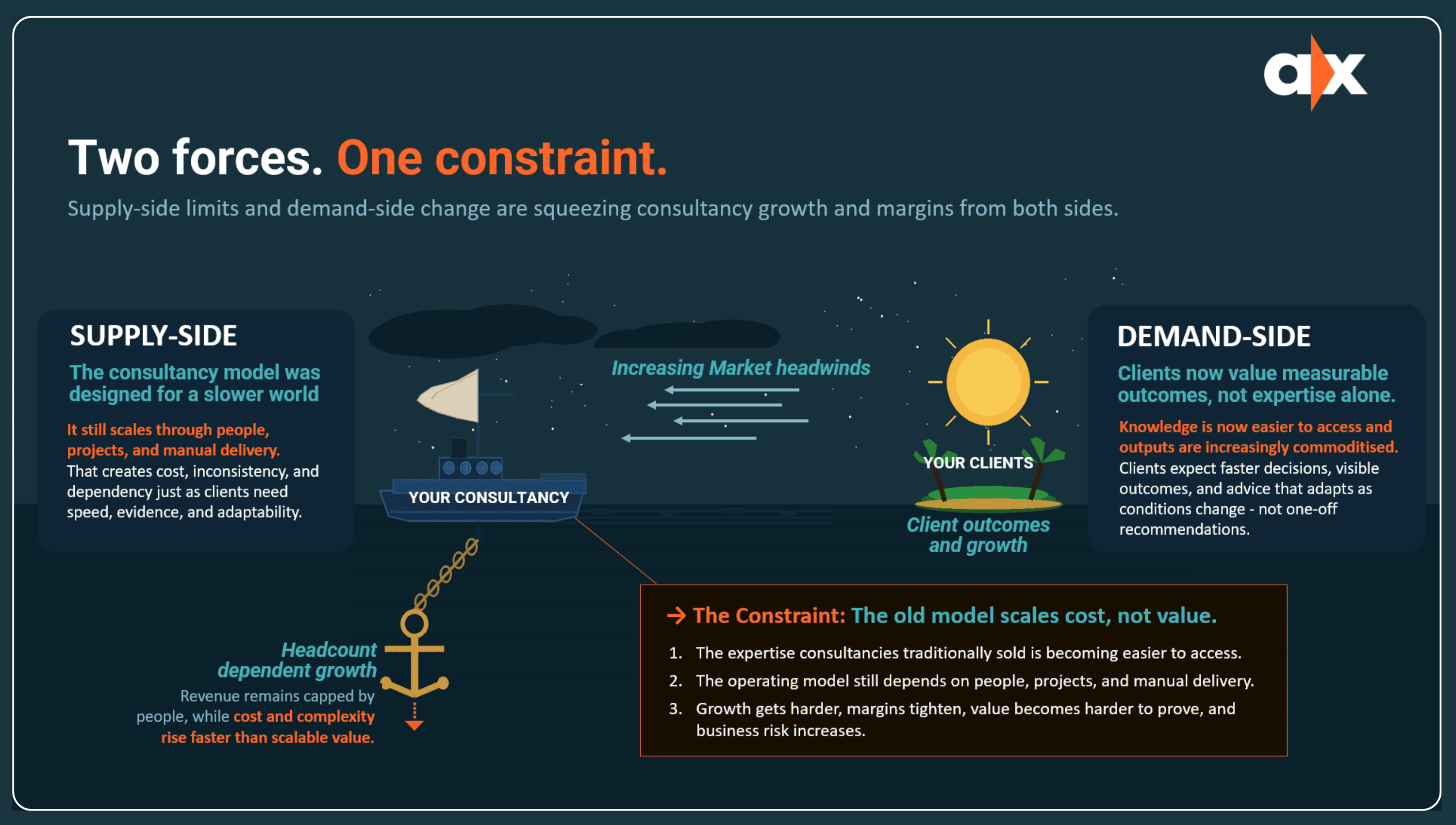
These two forces of supply and demand are now acting on consultancy at the same time.
On the demand side, clients increasingly value measurable outcomes, faster decisions, and delivery that adapts as conditions change - not access to expertise alone.
On the supply side, consultancy growth still depends heavily on people, projects, and manual delivery.
The expertise consultancies traditionally sold is becoming easier to access. But the operating model still depends on people, projects, and manual delivery. So, growth gets harder. Margins get tighter. Value becomes harder to prove. Business risk increases.
The constraint is simple: The old model scales cost, not value.
This is the squeeze now forming around consultancy. Clients want something different. The traditional model is expensive to scale. And AI is accelerating the gap between what the market needs and what the model was designed to deliver.
This is the new constraint for consulting.
Not AI adoption.
Not productivity.
Not even knowledge.
The constraint is the ability to deliver quality decisions that lead to measurable outcomes, continuously and at scale.
Why AI productivity is not enough
Many consultancies have responded to AI by focusing on consultant productivity. That is understandable. It is also useful. AI can help consultants work faster. It can reduce time spent on research, analysis, synthesis, drafting, content production, and project administration. It can improve efficiency. It can make delivery teams more productive.
But that does not mean it solves the underlying problem. A faster consultant is not the same as a scalable consultancy.
Using AI to accelerate traditional delivery may improve productivity at the individual level, but it does not necessarily change the model, create better decision-making, or connect actions to measurable outcomes - and it does not automatically make advice adaptive. It does not reduce dependency on headcount to grow a consultancy business.
But maybe more importantly, it does not automatically create a continuous client relationship or make the value of a consultancy easier to prove.
In some cases, it can even accelerate the pressure.
If AI makes traditional outputs easier and cheaper to produce, then the value of those outputs is compressed further. Reports, analysis, recommendations, and documents become easier for clients to generate themselves. The consultancy may be working faster, but the market may be valuing the old outputs less.
That is a real danger that some consultancies are already feeling.
AI adoption at consultant level can improve efficiency while leaving the strategic problem untouched. It can make the old model faster, without making it fit for the new market.
So the wrong question for consultancies is: How do we use AI to make consultants faster?
That question matters, but it is not enough. It keeps the focus inside the existing model.
A better question is: What model of consulting is required in a world where clients need faster, adaptive, evidence-led decisions that translate into measurable outcomes?
That question you ask yourself changes the direction of travel of your consultancy. It moves the discussion away from tools and towards operating model. Because the issue AI has exposed cannot be solved by tool adoption alone. It requires a change in how consulting creates value.
The direction of travel
This is why I believe consulting is moving towards Outcome-Led Consulting.
Not outcome-based pricing as a commercial label. Not simply promising results. Not rebadging existing projects with new language.
Outcome-Led Consulting is a deeper shift in the model. It means structuring consulting around measurable progress over time in how measurable outcomes are being delivered for a client.
That means defining the outcome clearly, understanding what needs to change to achieve it, guiding the decisions and actions required, measuring whether progress is happening, and adapting based on evidence. It means doing this continuously, not just at the start and end of a project.
That requires a different operating logic.
Consulting must move beyond one-off recommendations and towards adaptive advice. Beyond static plans and towards continuous progression. Beyond manual interpretation and towards systemised decision-making. Beyond people-dependent delivery and towards scalable models that can grow without adding headcount in direct proportion.
This does not remove the consultant, but it does change where the consultant adds value.
Human judgement, relationships, context still matters, and interpretation still matter. Trust still matters.
But the delivery logic cannot remain trapped entirely in individuals.
If consultancies are going to meet the market now forming, they need systems that help structure decisions, guide what happens next, connect actions to outcomes, and learn from evidence over time.
That is the beginning of the next model.
Closing
AI has created a faster world. But faster is not automatically better.
The organisations that win will not simply be those that act the fastest. They will be those that help clients make better decisions at speed, adapt as conditions change, and prove that their actions are creating measurable progress.
That creates a challenge for consulting.
The traditional model was built for a slower age: considered analysis, one-off recommendations, episodic projects, and people-led delivery.
That model is now being squeezed from both sides.
Clients need faster, adaptive, evidence-led decisions. Consultancies still rely heavily on people, projects, and manual delivery. AI makes traditional outputs easier to produce, while also increasing the pressure to deliver measurable value.
So, the question for consultancy leaders is not simply: Are we adopting AI?
They will.
The real question is: Are we using AI to accelerate the old model, or to build the model the market now requires?
Because the future of consulting will not be defined by who produces the most output. It will be defined by who can help clients make better decisions, adapt continuously, and deliver measurable outcomes at scale.
That is the new constraint.
And it is the challenge consultancies must now solve.