In my previous piece, ‘The New Constraint’, I set out the structural problem facing consultancy. AI has changed the market - not just by making work faster, but by shifting what clients value and exposing the limits of a model built for a slower world.
The conclusion was straightforward: the old model scales cost, not value. And using AI to make the old model go faster solves the wrong problem.
So what is the answer?
The short version is systemisation. But systemisation is a word that gets used loosely - and the way most firms approach it leaves the real problem untouched. Understanding why matters, because getting this wrong is easy, and many firms already are.
Systemisation is the right direction - but most firms stop too early
Most consultancies that recognise the need to change start by systemising what clients can see. They package expertise into clearer propositions. They create frameworks, templates, defined scopes, and branded methodologies. They build repeatability into how they go to market.
Systemising the visible layer creates progress. It brings structure, consistency, and commercial clarity. It is a necessary step.
But it plateaus. And it plateaus for a specific reason: productising what you sell is not the same as systemising how you deliver value.
A consultancy can have a beautifully packaged offer, a clear methodology, and a defined scope - while the actual delivery logic still sits entirely in the heads of its senior people.
The framework exists. But what the framework means in practice, how it gets applied to a specific client situation, which problem matters most, what should happen next, and whether progress is real - all of that is still being carried manually by individuals. It stays stuck in consultants' heads, PowerPoints, and personal files.
That is where scalability breaks down. And that is the part most systemisation efforts such as CRMs, Project and Time Management, and LLM use have never reached. But new possibilities with AI beyond using an LLM chatbot for consultant productivity are changing that constraint.
The consultancy evolution map
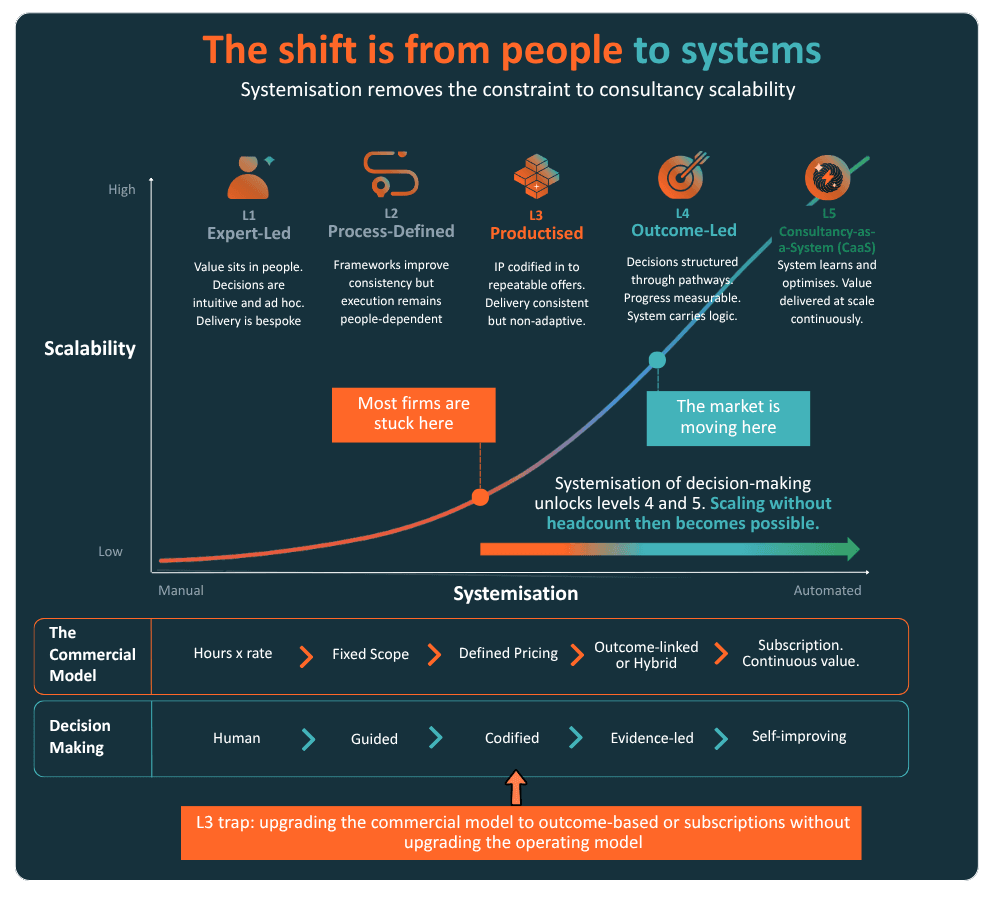
The evolution map shows five stages of consulting maturity - from expert-led delivery through to a fully systemised model. Most consultancies find themselves at level 2 or partway through level 3. That is not a failure - it is where genuine progress has been made. But it is also where most firms get stuck. In today's fast-evolving market, the move from level 3 to level 4 - from productised to outcome-led - is becoming the move that matters most.
It is worth being clear about what this model is not saying.
Not every service line, and not every type of consultancy, needs to reach level 4. Some engagements are naturally episodic. Some client relationships are transactional by design. Some consulting work is highly bespoke and strategic.
The purpose of the evolution map is not to prescribe a universal destination. It is to help firms understand where their current constraints sit, what level of maturity their strategy actually requires, and - critically - whether the model they are running is capable of delivering what their clients now need. But at the same time, the map sign-posts where the market is logically heading to provide insight for consultancies looking at planning ‘what next’ strategically.
The L3 trap
There is a trap that catches many consultancies at level 3 - and it is worth naming directly.
As firms feel the pressure to evolve, many respond by upgrading their commercial model. They introduce outcome-based pricing, subscription engagements, retained advisory, or hybrid models. These are logical moves. They signal awareness that the market is changing and that clients want something different.
But here is the problem: upgrading the commercial model without upgrading the operating model underneath it does not work. If the delivery logic still sits in people, outcome-based pricing creates risk without the system to manage it. Subscription models promise continuous value but cannot reliably deliver it. The proposition changes - the engine does not.
This is the L3 trap. The firm looks more evolved on the outside. The constraint remains on the inside.
The invisible layer: where scalability actually lives
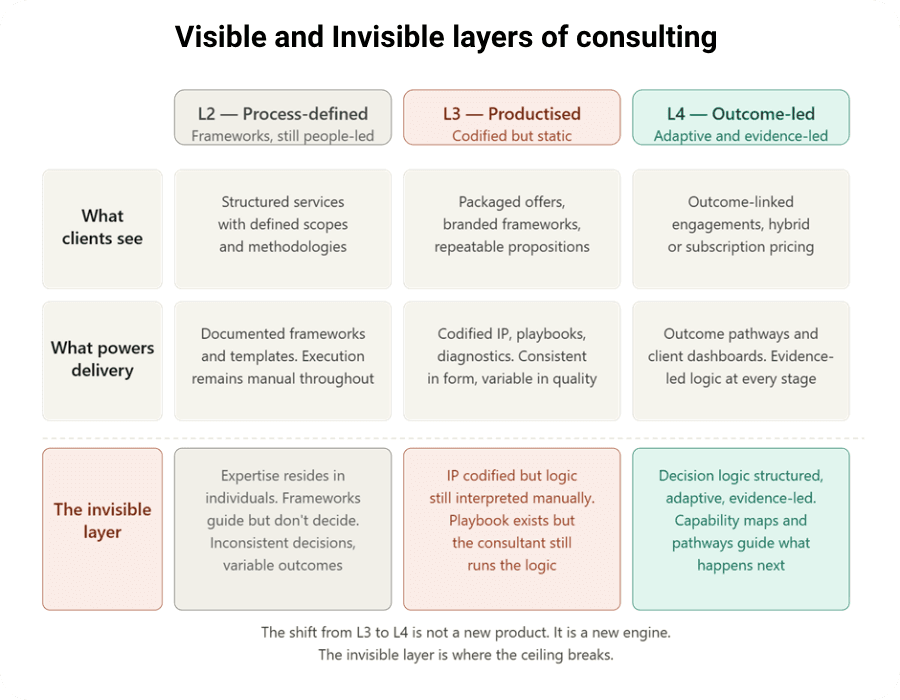
Most consultancies invest heavily in what clients see: the proposition, the deliverables, the methodology, the scope, the commercial model. These things matter. They shape how the firm goes to market and how clients understand what they are buying.
But scalability does not live there.
Scalability lives in the invisible layer - the logic that actually powers delivery. How decisions are made. Which capabilities need to change and in what sequence. How progress is defined and measured. How advice adapts as evidence changes. How learning compounds across engagements.
In most consultancies, that invisible layer sits entirely in individuals. It is in the senior consultant who knows how to interpret the diagnostic. The partner who knows what the client really needs. The experienced lead who knows which action should come next.
And this is precisely why scaling is so hard. More clients mean more senior people carrying the logic. More projects mean more partners in more rooms. Revenue grows - but so does headcount, fixed costs, and complexity. The model does not compound. It just gets heavier and relies on a constant stream of new business to pay for it.
No amount of AI productivity changes this. If the decision-making logic stays in people's heads, AI just helps those people produce outputs faster. The ceiling remains.
What it actually means to systemise decision-making
Systemising decision-making means making the invisible layer explicit - taking the logic that lives in experienced consultants' heads and structuring it in a way that can be applied consistently, tested against evidence, and improved over time.
Until recently, this was difficult to systemise in any practical way. AI changes that. What is now possible, in a way that was not before, is doing this at scale, across the full complexity of consulting engagement logic, and in a form that can adapt as evidence changes.
When that logic moves from the head of a senior consultant into a structured system, something important happens. It can be applied consistently. It can be tested against evidence. It can be repeated across clients. It can improve over time as more engagements provide more data. It can support a less experienced consultant with senior-quality decision logic.
Systemised decision-making in practice requires creating a structured logic that connects a defined client outcome to the capabilities that drive it, identifies what needs to change and in what sequence, and tracks evidence of whether progress is real. Not a rigid process that ignores context. A structured framework that makes expert judgement repeatable - and improves with every engagement.
The principle is clear. The execution is hard.
This is also where AI becomes genuinely powerful - not as a productivity layer on top of the old model, but as an enabling layer inside a structured one. When AI operates within defined decision logic, connected to outcome data and capability evidence, it can guide better decisions at scale. Without that structure, AI just produces more output. With it, AI scales value.
Why this is exactly what clients now need
Systemising the invisible layer matters because it solves both sides of the problem.
It helps consultancies reduce margin pressure and scale more effectively. But more importantly, it directly answers what clients now value: faster, adaptive, evidence-led decisions connected to measurable outcomes.
Clients are not simply looking for faster expertise. In an accelerating world, they need decisions that are connected to evidence. They need advice that adapts as conditions change, not advice that was right at the start of a project but becomes stale as reality moves on. They need visibility into whether progress is real - not an assertion of value at the end of an engagement, but a continuous and measurable account of what is improving and why.
A consulting model built around systemised decision-making delivers exactly that. When the logic is structured, progress becomes trackable. When outcomes are defined and capabilities are measured, evidence becomes visible. When the pathway adapts as evidence changes, the advice stays connected to reality rather than locked to an original plan.
This is what Outcome-Led Consulting means in practice. Not a rebranding of the existing model. A structural shift in what consulting is organised around - from producing deliverables to driving measurable client outcomes, guided by a system that makes that connection explicit and evidence-led.
The supply-side problem and the demand-side need point to the same answer. That is not a coincidence. The constraint the market is placing on consultancies, and the need clients are expressing, are two sides of the same structural shift. The firms that recognise this - and build towards it - will find themselves in a fundamentally stronger position than those still optimising the old model.
This is not just a theoretical argument for me. It is the problem that led us to build TheAX.
We saw consultancies trying to productise expertise, adopt AI, and improve productivity - but still struggling with the same underlying constraint: the decision logic that creates value remained locked in people.
TheAX is being built as an operating system for Outcome-Led Consulting: a way for consultancies to systemise decision-making inside their workflows, so they can deliver better outcomes and scale value without scaling headcount in direct proportion.
That is the future model I believe consulting is moving towards.
Not faster outputs.
You can explore more on the thinking behind TheAX, the challenges we see facing consultancies today, and the solution we see through our The shift page.